Burst fade haircuts use a curved fade zone that wraps around the ear. Its defining feature is placement, not one required top style or one required shortest length. A burst can finish at shadow, zero or skin and can connect to curls, a crop, a faux hawk, a mohawk or a mullet. The most reliable way to order it is to define the arc, the back shape, the top and the shortest finish separately.
Quick answer: ask for an ear-centered fade that curves from the temple, around the ear and toward the back while keeping the center-back shape you want. Then specify low or stronger placement, shadow/zero/skin, and whether the nape should stay longer or blend tighter.
A burst fade is identified by its ear-centered arc. Height and shortest finish are separate decisions.
Burst Fade Haircuts: What Makes the Shape Different?
The fade appears to radiate from the ear in a semicircular or sunburst pattern. Unlike a fade that travels at roughly the same height across the entire side and back, the burst is localized. That is why it can create strong side contrast while preserving a darker strip or longer silhouette through the rear.
Decision
Options
What changes visually
Arc placement
Lower/subtle or higher/stronger
How much contrast surrounds the ear
Shortest finish
Shadow, zero or skin
Softness, scalp exposure and grow-out visibility
Back treatment
Retained, tapered or more connected
Mullet/faux-hawk shape versus a cleaner rear
Top
Crop, curls, coils, mohawk, faux hawk or mullet
The overall identity of the haircut
Edge work
Natural, softly cleaned or sharp lineup
How graphic the perimeter appears
Burst Fade vs Regular Fade
Burst fade
Regular fade
Shape
A curved arc around the ear
A line at roughly the same height around the head
Back of the head
Stays longer behind the arc
Faded across the back
Pairs well with
Mullets, faux hawks, mohawks, curly tops
Almost any top
How it looks
A shape you notice
Even and familiar
If you’re unsure, start with the regular fade’s height you like and ask for it “curved around the ear, keep the back longer”. That is the burst.
Burst Fade Placement: Side and Rear Views
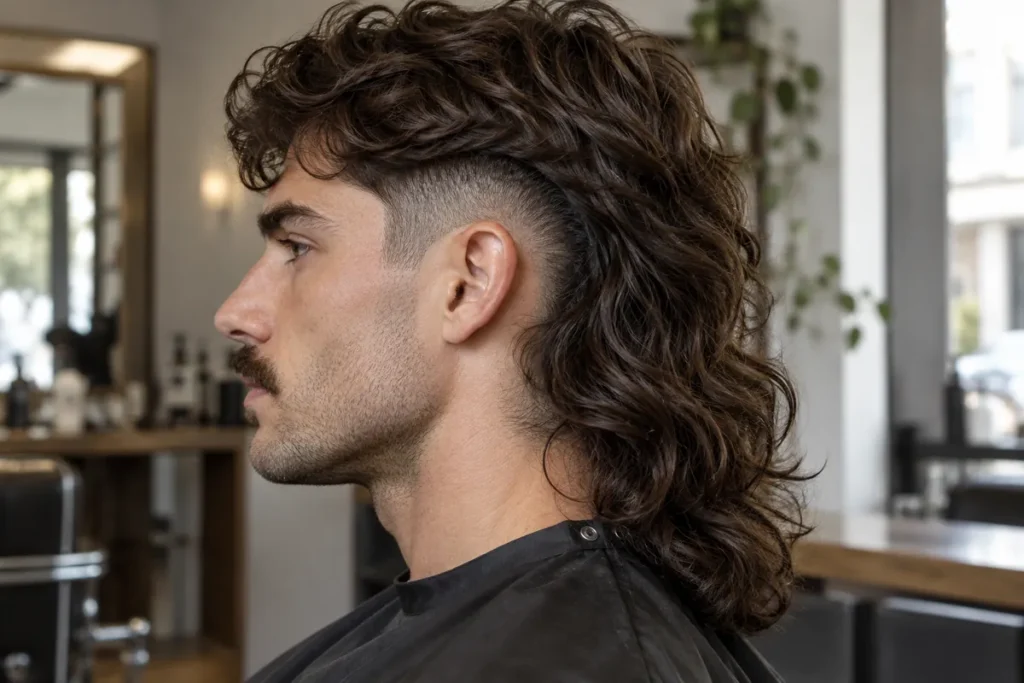
The burst concentrates contrast around the ear while allowing more length to remain toward the center back and nape.
From the side, look for the blend to curve closely around the ear rather than continue as a broad horizontal band. The amount removed above and behind the ear determines whether the result looks subtle or dramatic. A higher arc exposes more of the side; a lower arc keeps more weight.
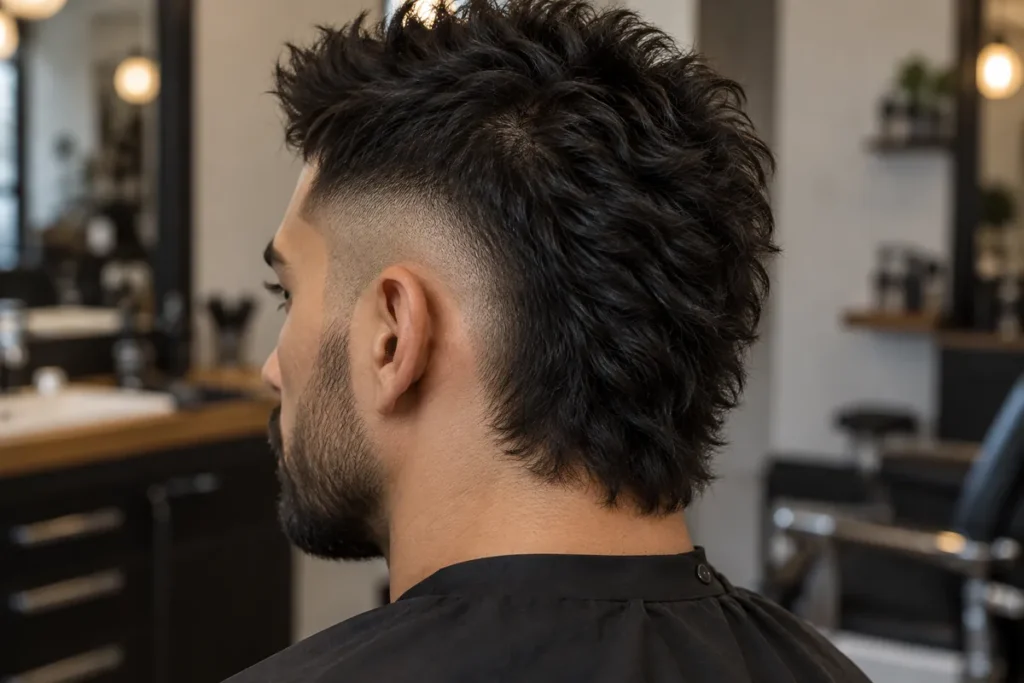
From the rear, the center back can stay darker than it would with a connected drop or full fade.
The rear view is where many haircut requests go wrong. If you want a mullet or faux-hawk silhouette, tell the barber how much center-back and nape length to retain. If you want a cleaner everyday result, ask for the rear to taper into the neckline without turning the entire cut into a drop fade.
For a direct placement comparison, see burst fade vs drop fade. If you are choosing between a localized ear arc and a perimeter cleanup, use burst fade vs taper fade.
Types of Burst Fade: Low, Mid and Strong
These labels are not perfectly standardized between barbershops. Use them as a starting point, then show a side-view reference and point to where the arc should peak.
Low burst fade: keeps the shortest work close to the ear and preserves more side weight. It usually grows out more softly.
Mid burst fade: creates a clearer arc and stronger separation between the top and lower side.
High or strong burst fade: removes more weight around the ear and makes the top/back silhouette more dramatic.
Do not rely on height language alone. “Low” to one barber can look like “mid” to another, especially on different head shapes and hairlines.
Shadow, Zero or Skin Burst Fade?
Choose the shortest finish separately: shadow leaves visible hair, zero is clipper-close, and skin removes hair at the base.
Shadow burst fade: leaves visible short hair at the base. It provides the softest contrast and least obvious regrowth.
Zero burst fade: finishes very close with clippers but does not automatically mean foil-shaved bare skin.
Skin burst fade: removes hair to the skin at the lowest point. It creates the strongest contrast and shows growth sooner.
Finish and placement are independent. You can ask for a low skin burst or a higher shadow burst. State both choices.
Best Top Styles for Burst Fade Haircuts
Top style
Why the pairing works
Key instruction
Mullet
The ear arc separates the side while the rear stays long
Define how much nape length must remain
Faux hawk
The curved sides direct attention toward a central ridge
Keep enough width through the top/back to avoid a thin strip
Mohawk
Creates maximum side contrast
Agree on strip width and rear connection before cutting
Curls or coils
Maintains texture above the ear while sharpening the outline
Account for shrinkage and avoid taking the arc too high
Short crop
Gives a practical compact top with a more distinctive side shape
Straight hair: makes the arc and any weight line easy to see, so the transition must be especially clean.
Wavy hair: adds movement above the fade and can soften the boundary between short and long sections.
Curly hair: creates strong volume contrast; cut the arc with the dry curl position in mind.
Coily hair: supports crisp silhouettes and detailed line work, but the barber should protect the natural hairline and account for shrinkage.
Fine or low-density hair: often benefits from a lower, softer arc because aggressive side exposure can make contrast feel harsher.
What to Tell Your Barber
“I want a burst fade centered around the ear. Keep the arc [low/subtle or stronger], finish the shortest point at [shadow/zero/skin], and keep the center back and nape [longer/tapered/clean]. On top I want [style and approximate length]. Please show me the arc placement before taking it higher.”
Bring one side photo and one rear photo. A single front-facing image cannot communicate the two most important burst-fade decisions.
Maintenance and Grow-Out
There is no universal appointment schedule. A skin finish and sharp lineup show change faster than a shadow finish and natural edge. Higher contrast also makes regrowth more noticeable. Rebook when the ear arc no longer reads the way you want, not because a generic article says every client needs the same interval.
Common Burst Fade Mistakes
The arc travels too far into the back and becomes a drop fade.
The barber removes the nape length needed for a mullet or faux-hawk shape.
“Skin” is assumed even though the client wanted a softer shadow finish.
The fade rises too high above the ear and weakens curl or coil volume.
Only one reference angle is supplied, leaving the rear shape undefined.
More visual references
Long wavy rear length contrasts with the shorter area around the ear. AI-generated editorial illustration.A coily ridge remains through the top and rear, with more exposed hair around the ear. AI-generated editorial illustration.The rear view shows how a textured central ridge can remain darker than the ear area. AI-generated editorial illustration.
What are burst fade haircuts?It is a fade whose short-to-long transition curves around the ear in an arc. The top style, height and shortest finish can all vary.
Is a burst fade the same as a drop fade?No. A burst is centered around the ear and can retain more center-back length. A drop fade continues as a connected band that curves lower behind the ear and through the back.
Does a burst fade have to go to skin?No. It can finish at shadow, zero or skin. Ask for the finish separately from the placement.
Can a burst fade work without a mullet?Yes. It can pair with a short crop, curls, coils, a faux hawk, a mohawk or other tops. The mullet is only one popular combination.
What photos should I show my barber?Bring at least one side view showing the ear arc and one rear view showing how much center-back and nape length should remain.



 Low Burst Fade: 5 Styles & What to Tell Your Barber
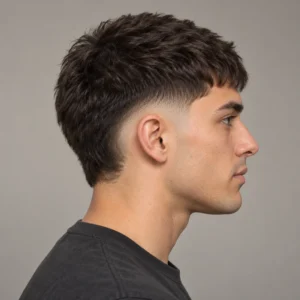
 Straight Hair Burst Fade Crop: Shape & Barber Guide
 Coily Burst Fade Faux-Hawk: Shape & Barber Guide
One Comment