Burst Fade vs Taper Fade: Differences, Maintenance & Which to Choose
On this page
- Burst Fade vs Taper: Ear, Temple and Nape Views
- What is a taper?
- What is a burst fade?
- What Does “Burst Taper” Mean?
- Burst fade vs taper fade: which looks better for your hair texture?
- What about face shape?
- Which is more professional?
- Maintenance and grow-out
- What to tell your barber
- Common mistakes
- Frequently asked questions
Quick answer
Burst fade vs taper fade comes down mainly to placement, contrast, and how much length you want to keep through the sides and back. A burst fade curves around the ear and often preserves more length through the nape, while a taper concentrates the shortest graduation at the temples and neckline. Neither style has to finish at bare skin
| Feature | Burst fade | Taper |
|---|---|---|
| Where it blends | Curves around the ear | Concentrates at the temples and neckline |
| Back length | Often kept longer through the nape | Most side/back length stays fuller except at tapered edges |
| Visual contrast | Medium to bold | Subtle to medium |
| Must it go to skin? | No | No |
| Typical maintenance range | About 2–4 weeks, depending on growth and finish | About 2–5 weeks, depending on growth and finish |
| Common pairings | Mullets, faux hawks, textured and curly tops | Classic, flow, side-part and professional styles |
Maintenance varies: these ranges describe how long many people keep a fade looking deliberately crisp, not a required appointment schedule. Hair growth, shortest length and personal preference all change the timing.
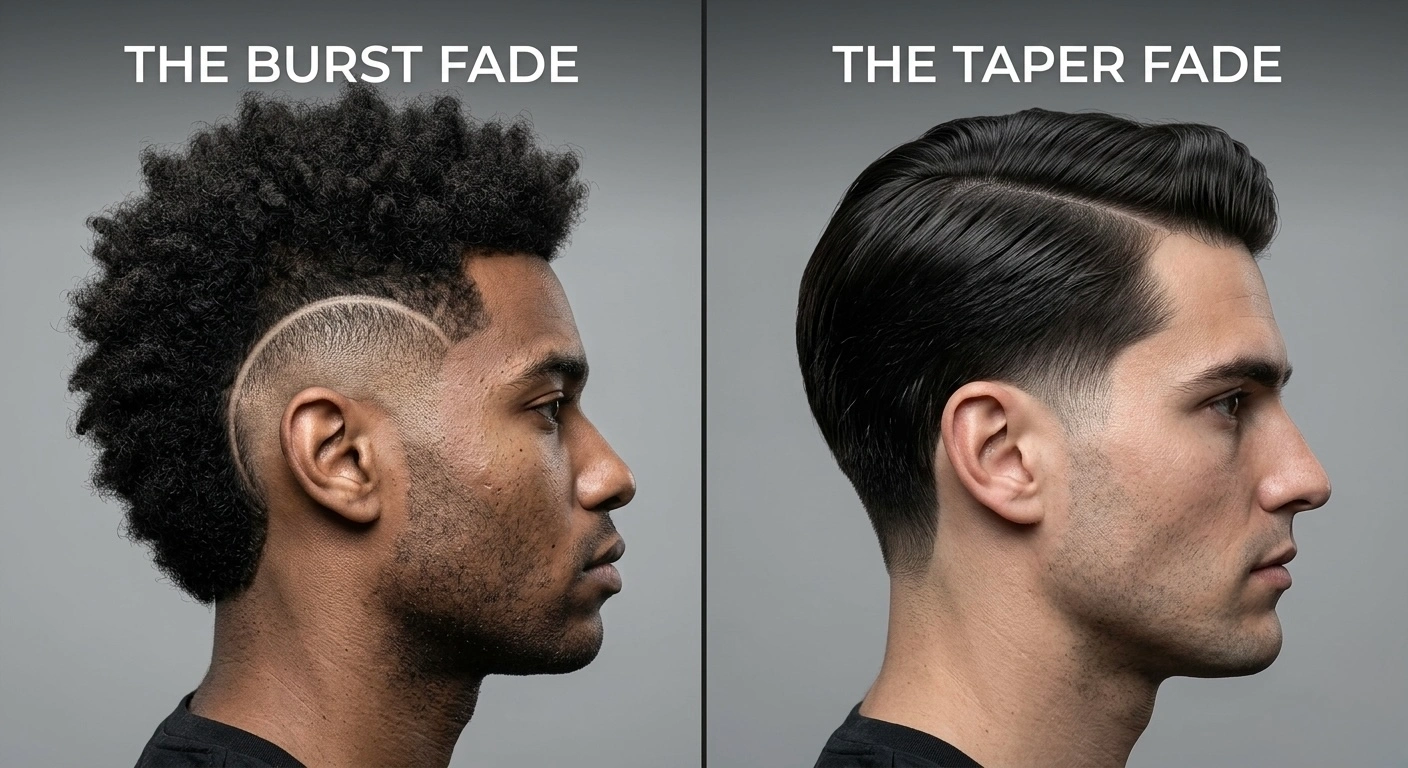
Curved around the ear
The shortest blend follows a rounded arc around the ear while more length can remain through the back.
Temples + neckline
The shortest graduation stays localized around the sideburn/temple area and the nape rather than forming one full faded band.
Burst Fade vs Taper: Ear, Temple and Nape Views
A burst changes the area around the ear. A taper concentrates the shortest graduation at the temple and nape while retaining more center-side weight.


What is a taper?


A taper gradually shortens selected areas at the edges of the haircut rather than removing the sides and back as one continuous faded band. In current barbershop use, the shortest zones are usually around the temples or sideburns and the nape. Hair above and behind the ear can remain comparatively full.
The shortest point varies. A shadow taper keeps visible hair at the bottom; a skin or bald taper can finish at bare skin in the small tapered zones. Asking for “a taper” does not automatically mean asking for skin.
What is a burst fade?
A burst fade creates a rounded or semicircular transition around the ear. Depending on the haircut, the arc may stay tight to the ear or extend higher toward the temple and back. More length is often preserved through the nape, which is why burst fades pair well with mullets, faux hawks, mohawks and textured shapes.
A burst can also be a shadow, zero or skin finish. The words burst fade describe the placement and curve of the blend, not one mandatory clipper length.
What Does “Burst Taper” Mean?
Burst taper is not one standardized technical haircut name. It is commonly used for a lower or softer burst fade: the blend still forms a rounded arc around the ear, but the shortest area may stay tighter to the perimeter and preserve more weight through the sides and back. Some people also use the phrase loosely as another name for a burst fade, so the words alone do not guarantee one exact result.
| Phrase | Likely meaning | What to clarify |
|---|---|---|
| Burst taper | Usually a lower or softer ear-centered burst | Arc height, back length and shadow/zero/skin finish |
| Burst fade | A rounded fade zone centered around the ear | How wide or strong the arc should be |
| Taper | Separate cleanup at the temple/sideburn and neckline | Whether hair around and behind the ear should stay full |
If you found this page by searching for “burst taper,” show your barber a clear side and rear reference and say: “Keep the blend rounded around the ear, preserve the back, and finish the shortest point at [shadow / zero / skin].” For the broader haircut family, see burst fade haircuts. For the general coverage difference without the burst shape, compare fade vs taper.
Burst fade vs taper fade: which looks better for your hair texture?
Straight hair
A taper can preserve side density for flow, side parts and classic shapes. A burst creates stronger separation around the ear and can sharpen a textured or longer-back silhouette.
Wavy hair
Both can work well. Choose based on how much side weight you want to keep and whether you want the back to remain fuller.
Curly hair
A burst can frame curls dramatically, while a taper keeps more curl density through the sides. Neither is universally better.
Coily hair
Both placements can complement coily hair. The best result depends on top shape, density, desired contrast and the amount of hair preserved at the sides and back.
What about face shape?
Face shape can be a useful styling clue, but it should not be treated as a mathematical rule. Top height, side width, beard shape, density and head shape all affect the final result. If you want to create more apparent height, keep more volume on top; if you want a softer outline, avoid taking the fade unnecessarily high.
Which is more professional?
A low or shadow taper is usually the safer choice in conservative workplaces because it changes less of the side profile. A burst fade can still look polished when the arc is kept controlled, the top is tidy and the back is intentionally shaped. Workplace standards vary, so the exact height and shortest length matter more than the haircut name alone.
Maintenance and grow-out
These are practical ranges, not guarantees. Fast growth, a skin-tight finish and a sharp line-up can make a haircut look less crisp sooner. A softer shadow finish generally shows regrowth less dramatically.
What to tell your barber
Reference photos are still valuable. Show at least one clear side view and, when the neckline matters, a back view as well.
Common mistakes
- Asking only for “a taper fade” without explaining where you want the shortest area.
- Not specifying skin, zero or shadow finish.
- Showing only a front-view reference photo.
- Choosing a reference whose hair texture and density are very different from yours without discussing how the result will adapt.
- Assuming haircut terminology is identical in every barbershop.
For more context, see our fade haircuts for men guide.
Frequently asked questions
Is a burst fade the same as a taper?
No. A burst fade curves the blend around the ear. A taper usually concentrates the shortest graduation at the temples and neckline while preserving more hair through the sides.
Does a burst fade have to be bald?
No. A burst fade can finish at skin, zero or a longer shadow length. “Burst” describes the curved placement around the ear.
Does a taper have to go to skin?
No. A shadow taper keeps visible hair at the shortest point, while a skin or bald taper can finish at bare skin in the tapered zones.
Which usually grows out more softly?
A taper often has a softer grow-out because less of the side and back is taken very short, but growth rate and the chosen shortest length make a large difference.
Can straight hair get a burst fade?
Yes. Straight hair can wear a burst fade, especially with textured crops, faux hawks, mullets or longer-back styles.
Can curly hair get a taper?
Yes. A taper can preserve curl density through the sides while cleaning the temples and neckline.
Which needs less maintenance?
A soft taper often needs fewer crisp-up visits than a skin-tight burst fade, but maintenance depends on growth speed, fade length and how sharp you want the outline.
What reference photos should I show my barber?
Use a clear side view and, if the neckline or back length matters, a back view. Choose examples with hair texture and density reasonably close to yours when possible.
 Fade vs Taper: Differences, Photos & Barber Scripts
 Fade vs Undercut: Key Differences & Which to Choose
 Mid Taper vs Low Taper: Differences, Height & Which to Choose
One Comment