Mid Taper vs Low Taper: Differences, Height & Which to Choose
On this page
- Low Taper vs Mid Taper: Placement Views
- Mid Taper vs Low Taper: The Main Differences
- What Is a Low Taper?
- What Is a Mid Taper?
- Mid Taper vs Low Taper for Different Hair Types
- Which Taper Is Better for Your Face Shape?
- Which Looks More Professional?
- Mid Taper vs Low Taper Maintenance
- What to Tell Your Barber
- Common Mistakes to Avoid
- Still Not Sure Which Taper to Choose?
- Frequently Asked Questions
- Mid Taper vs Low Taper: Final Choice
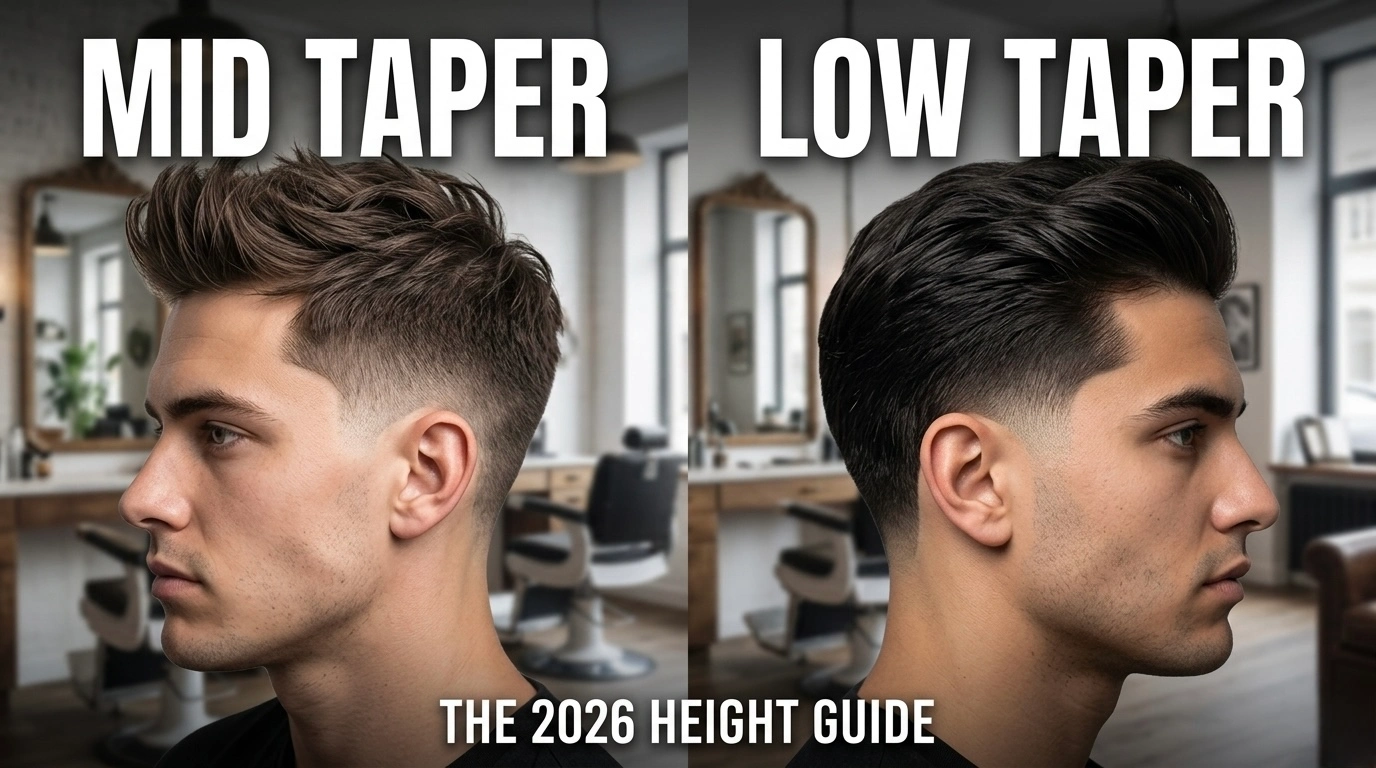
Mid taper vs low taper comes down mainly to where the shortest part of the blend begins and how much contrast you want around the temples and neckline. A low taper keeps the transition close to the edges of the haircut for a subtle finish, while a mid taper starts slightly higher and creates a more noticeable blend. Neither style has to go to bare skin.
Choose a low taper if you want to preserve more weight through the sides and keep the haircut understated. Choose a mid taper if you want the temple and neckline blend to be more visible without turning the whole side into a full fade.

Low Taper vs Mid Taper: Placement Views
Compare the visible height of the temple blend, then use the rear view to confirm how much weight remains through the sides and back.


Mid Taper vs Low Taper: The Main Differences
The biggest difference is blend height. Both styles usually concentrate the shortest graduation around the temples, sideburns and neckline rather than fading the entire side of the head. What changes is how high that transition travels and how much surrounding hair is removed.
| Feature | Low Taper | Mid Taper |
|---|---|---|
| Blend position | Kept close to the temples, sideburns and neckline | Starts slightly higher around the temple and sideburn area |
| Side fullness | Preserves more visible weight | Removes slightly more side weight |
| Contrast | Subtle to moderate | Moderate to stronger |
| Must it be skin? | No | No |
| Grow-out | Usually looks softer as it grows | The higher transition can become noticeable sooner |
| Best for | Subtle, classic and fuller-side styles | More visible contrast and sharper side definition |

What Is a Low Taper?
A low taper fade keeps the shortest part of the haircut very close to the perimeter. The transition is usually concentrated around the sideburn or temple edge and again at the neckline, while most of the hair above and behind the ear remains comparatively full.
That makes a low taper useful when you want the edges cleaned up without removing much of the haircut’s overall width. It can work with straight, wavy, curly or coily hair because the barber can adapt the shortest length and amount of weight removed to the individual style.
A low taper can be finished as a shadow taper, zero taper or skin taper. Asking for “low” describes the placement; it does not automatically specify how short the bottom should be.
What Is a Mid Taper?
A mid taper fade moves the transition somewhat higher around the temple and sideburn area. This creates more separation between the longer hair above and the shorter perimeter while still leaving considerably more side and back length than a full mid fade.
The exact height is not a universal line measured from the ear. Barbers can adapt it according to head shape, hair density, top style and the reference image you provide. That is why showing a clear side-view photo is more useful than relying only on the phrase “mid taper.”
Mid Taper vs Low Taper for Different Hair Types
Straight Hair
Straight hair can make changes in blend height especially visible because the side weight often forms a clean, readable silhouette. A low taper preserves more density for side parts, flow styles and classic cuts. A mid taper can create stronger separation when the top is textured, brushed up or styled with more volume.

See our mid taper guide for straight hair for more examples and styling ideas.
Wavy Hair
With wavy hair, both heights can work well. A low taper keeps more of the natural wave through the side, while a mid taper can make the textured top look more defined by reducing some weight around the temple.
For more examples, visit our mid taper fade for wavy hair guide.
Curly and Coily Hair
Curly and coily textures can carry either taper well. The decision is less about a rigid rule and more about how much volume you want to retain around the side of the head. A low taper preserves more curl or coil density, while a mid taper creates a clearer break between the top shape and the perimeter.

Which Taper Is Better for Your Face Shape?
Face shape can be one styling consideration, but it should not dictate the haircut on its own. Top height, side width, beard shape, hair density and head shape all influence the final silhouette.
If you want to create the appearance of more height, keeping some volume on top and controlling side width may help. If you prefer a softer outline, preserving more side weight with a low taper can be useful. A mid taper creates slightly more visible separation, but neither style is automatically “correct” for one face shape.
Which Looks More Professional?
Both can look professional. A low taper is usually the more conservative choice because it changes less of the side profile. A mid taper can still look polished when the transition is controlled and the top is neatly styled.
For workplaces with stricter grooming expectations, ask for a shadow or zero finish rather than assuming you need a skin-tight blend.
Mid Taper vs Low Taper Maintenance
There is no mandatory two-week schedule for either cut. How long a taper looks crisp depends on hair growth, the shortest guard used, whether the bottom reaches skin, the sharpness of the line-up and your personal preference.
- Low taper: often grows out softly because much of the side weight remains.
- Mid taper: the higher transition may become visually softer sooner because more of the blend is exposed.
- Skin finishes: usually show regrowth sooner than shadow or longer finishes.
- Line-ups: may lose their sharp appearance before the taper itself needs to be completely redone.
Instead of following a fixed calendar, refresh the cut when the outline no longer looks the way you want it to.
What to Tell Your Barber
Low Taper Request
“I want a low shadow taper at the temples and neckline. Keep the hair above and behind the ear full, and don’t turn it into a full fade around the sides.”
Mid Taper Request
“I want a mid taper around the temples and neckline with a little more contrast than a low taper. Keep the rest of the sides full and don’t take the blend too high.”
Always show your barber a clear side-view reference image. If neckline shape matters to you, bring a back-view reference as well.
Common Mistakes to Avoid
- Asking only for “a taper” without specifying low or mid placement.
- Assuming every taper automatically means bare skin.
- Confusing a mid taper with a full mid fade.
- Choosing a reference image with a very different hair texture without discussing how the result will adapt.
- Focusing only on face shape and ignoring top length, density and styling habits.
- Expecting every barber to use haircut terminology in exactly the same way.
Still Not Sure Which Taper to Choose?
Use our Fade Calculator to compare your preferred contrast, maintenance level and hair texture, or continue with our broader haircut comparison guides.
Frequently Asked Questions
What is the main difference between a mid taper and a low taper?
A low taper keeps the shortest blend closer to the edges of the haircut. A mid taper moves that transition slightly higher, creating more visible contrast around the temple and sideburn area.
Does a low taper have to go to skin?
No. A low taper can finish as a shadow taper, zero taper or skin taper depending on how short you want the bottom of the blend.
Does a mid taper have to be a skin fade?
No. “Mid” describes the general placement of the taper, not the shortest clipper length. You can ask for a shadow, zero or skin finish.
Which taper grows out better?
A low taper often appears to grow out more softly because more side weight remains, but growth rate and the shortest length used make a major difference.
Which is better for thick hair?
Both can work with thick hair. A low taper preserves more side density, while a mid taper removes slightly more weight around the temple for greater contrast.
Is a mid taper the same as a mid fade?
No. A mid taper normally concentrates the shortest graduation around the temples and neckline. A mid fade usually carries the blend farther around the sides and back.
How often should I refresh a taper?
There is no fixed schedule. Refresh it when the edges and blend no longer match your preferred level of sharpness. Skin-tight finishes generally show regrowth sooner than shadow finishes.
Mid Taper vs Low Taper: Final Choice
When deciding between mid taper vs low taper, choose based on how visible you want the transition to be. Go lower if you want to preserve maximum side fullness and a softer grow-out. Move to a mid taper if you want slightly stronger contrast around the temples without committing to a full fade.
The safest approach is to bring a side and back reference photo and discuss the shortest length, taper height and amount of side weight you want to keep before the haircut begins.
For professional taper-fade education and cutting demonstrations, you can also review Andis barber and stylist education .
 Fade vs Taper: Differences, Photos & Barber Scripts
 Fade vs Undercut: Key Differences & Which to Choose
 Burst Fade vs Taper Fade: Differences, Maintenance & Which to Choose
One Comment