
7 Tips for the Perfect Burst Fade for Coily Hair (Guide)
On this page
The Ultimate Guide to the Perfect Burst Fade for Coily Hair
When dealing with 3C to 4C hair types, framing the natural afro texture is paramount. If you want a look that is explosive yet highly tailored, the perfect burst fade for coily hair stands entirely unrivaled in the realm of modern barbering. In the first 100 words of this masterclass, we will establish exactly why the perfect burst fade for coily hair provides the ultimate explosion of texture while maintaining a rigorously clean perimeter. Unlike standard fades that run straight across the head, the burst fade drops in a dramatic semi-circular arc around the ear, creating a striking “burst” of bare skin. This geometry acts as a high-contrast picture frame, drawing the eye directly to the dense, rich volume of the coils on top and at the nape.
The Anatomy of the Perfect Burst Fade for Coily Hair Silhouette
The core philosophy behind this haircut is the manipulation of visual weight. Coily hair, by its very nature, grows outward and upward with immense volume. If left entirely to its own devices on the sides, it can swallow the ears and create an incredibly spherical, unflattering shape. The burst fade acts as an architectural intervention. By aggressively removing the bulk localized directly around the ear and dropping the fade down to the absolute skin, the barber creates a sharp, mechanical contrast against the organic, three-dimensional complexity of natural textures.
Furthermore, because the burst fade drops down behind the ear instead of fading straight across the back, it intentionally leaves a thick column of hair at the nape of the neck. This creates a faux-hawk or modern mullet silhouette, pulling the visual momentum toward the back of the head. The result is an elongated, far more dynamic profile that commands attention. It proves that natural hair does not need to be cut off completely to look impeccable—it just needs the right frame, which is exactly what the perfect burst fade for coily hair provides.
Execution: Communicating for the Perfect Burst Fade for Coily Hair
The success of the perfect burst fade for coily hair depends entirely on your barber’s geometric precision. You must communicate clearly before the clippers even turn on. First, specify the width of the burst. For coily hair, a “wide burst” is almost always preferred. A wider burst extends further up into the parietal ridge and pushes deeper toward the back of the head, ensuring that the sheer volume of the coils does not overshadow the fade itself.
Second, the lineup (or edge-up) is non-negotiable. The C-cup around your temple must be carved flawlessly with a straight razor. The stark juxtaposition between a mathematically straight, artificial razor line and the wild, organic chaos of the hair on top is the defining hallmark of elite grooming. If the lineup is soft or pushed back, the entire haircut loses its impact.
Finally, address the top. The top of the hair needs to be shaped to achieve the perfect burst fade for coily hair. Have your barber use a pick to lift the coils to their maximum extent, and then free-hand trim the absolute longest, unruly stragglers to create a cohesive, rounded canopy that flows seamlessly into the heavier back section.
Moisture and Definition: The Science of Coils
A burst fade looks violently sharp on the sides, but if the coily hair on top is dry, brittle, or frizzy, the aesthetic collapses entirely. Coily hair possesses a zig-zag shaft, making it incredibly difficult for natural scalp oils (sebum) to travel from the root down to the ends. Therefore, aggressive, daily, and intentional hydration is mandatory. You cannot achieve the perfect burst fade for coily hair with neglected, dry coils.
The foundation of your routine is the Leave-In Conditioner. After washing, while the hair is still damp, massage a high-quality, water-based leave-in conditioner deeply into the scalp and through the ends. Expert groomers and publications like GQ highly recommend specialized hydrating creams to trap moisture inside the cuticle. This prevents the dreaded “shrinkage” where coils dry up into tight, dense balls. Once the moisture is applied, you must seal it. Use a lightweight natural oil—like Argan, Jojoba, or Sweet Almond oil. Stay completely away from heavy, petroleum-based greases that clog pores.
Styling the Perfect Burst Fade for Coily Hair
To maximize the “explosion of texture” that makes the perfect burst fade for coily hair so sought after, you need to define the individual curl clumps. The most efficient tool for this is the Curl Sponge or a Styling Racket.
Apply a nickel-sized amount of curling cream directly to the canopy of the hair. Take the curl sponge and gently rub it in small, consistent, circular motions across the entire top and back of the head. It is critical that you only rub the sponge in one direction (clockwise or counter-clockwise). If you switch directions, you will unravel the coils you just created. This technique groups the individual strands into perfectly defined, twisting dread-like coils that stand out dynamically against the blurry, smooth gradient of the fade below. This is the ultimate secret to styling the perfect burst fade for coily hair.
Schedule and Maintenance Strategies
There is a stark duality in maintaining this aesthetic. The coily hair itself requires very little mechanical cutting. Because natural textured hair retains its shape beautifully, the top canopy and the nape only require a light dusting of split ends once every six to eight weeks. This allows you to continuously build length and volume over time.
However, the sides of the perfect burst fade for coily hair are incredibly fragile. The fade goes from absolute skin up to a #2 guard within an inch of real estate. As the hair grows at its normal rate of half an inch per month, the clear, stark arc of the burst will soften and become blurred within 14 days. To maintain the aggressive contrast that makes the perfect burst fade for coily hair work, you must book a fade touch-up with your barber every two to three weeks. If you allow the stubble to fill in around the ears, the visual impact is lost permanently.
Looking to explore other elite textured styles? Check out our Modern Burst Fade Mullet Guide for a longer variation, or explore how to seamlessly blend your facial hair in our guide to Connecting a Burst Fade with a Beard. If you want to drop the length entirely, read about the Short Burst Fade for Low Maintenance Style.
Coily burst fade: ear arc and center-back choices
Visual disclosure: The new realistic references below are original AI-generated editorial illustrations of fictional adults. They illustrate haircut choices, not real client results. Compare the visible shape with your own hair and discuss adaptations with your barber.
A burst fade describes the curved short zone around the ear. It does not require a tall faux-hawk, a long mullet, a wide skin finish or a razor lineup. These compact examples focus on the fade boundary and retained back, giving this page a different purpose from the separate coily burst fade faux-hawk guide.
Side view: a rounded ear-centered transition
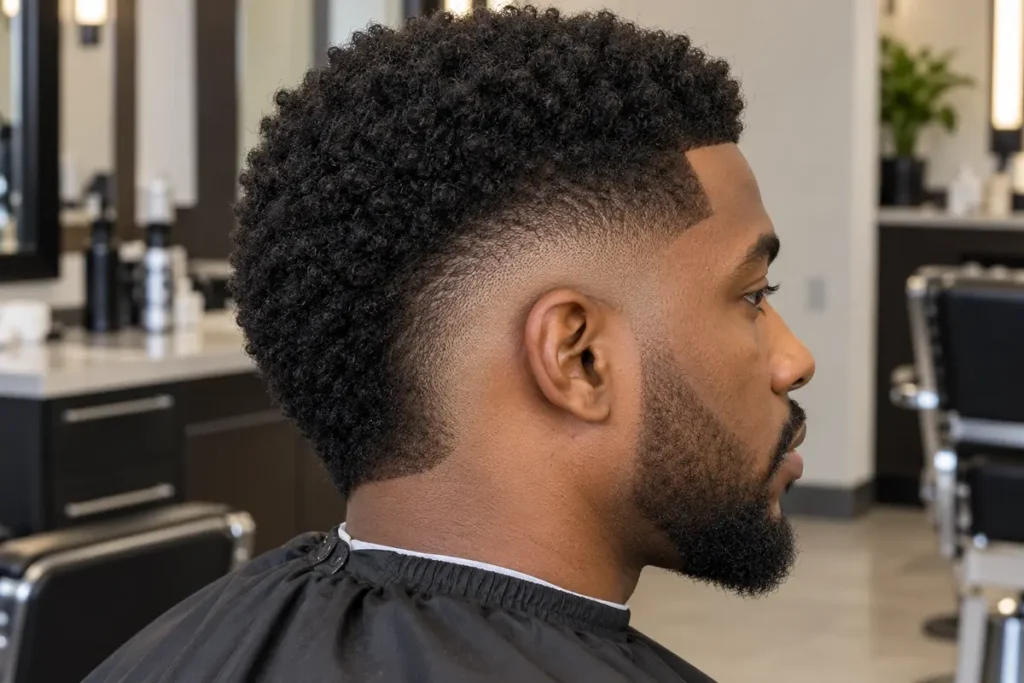
Trace the short area around the ear, then the dark hair that remains above and behind it. The top is rounded rather than forced into a center ridge. Tell your barber how far the arc may extend behind the ear and how much side weight should stay. A reference can communicate that boundary more clearly than “wide” or “low” alone.
Rear view: keeping a compact center back
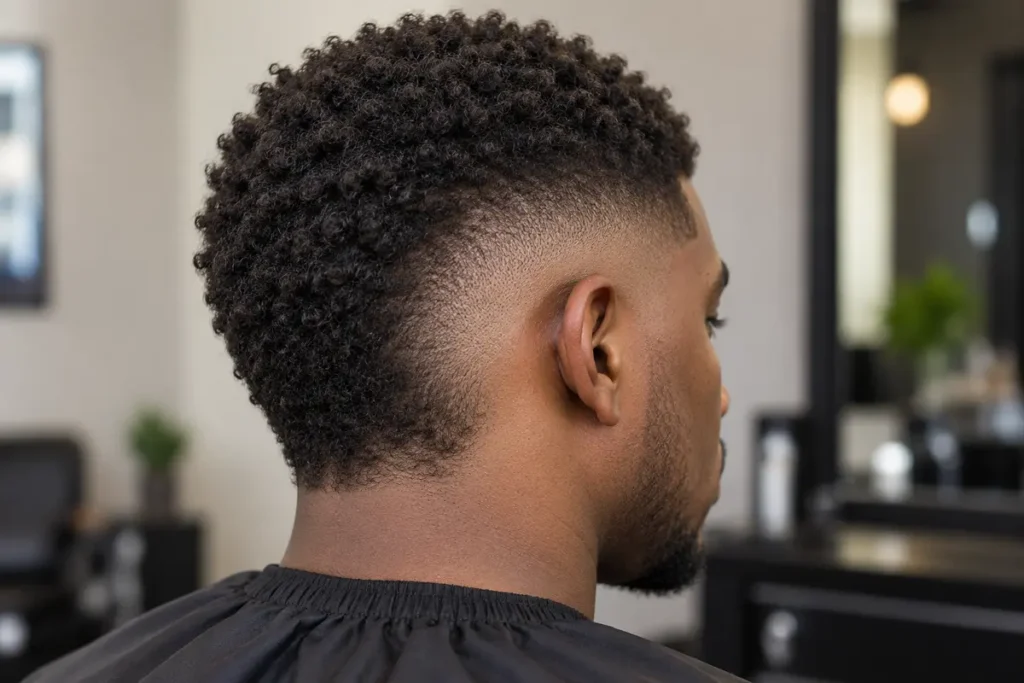
The back remains dark and compact while the short ear area sits to one side. This shows why a burst does not automatically mean a mullet: rear length is a separate choice. If you want an even shorter top, compare short burst fade options.
Clarifications for the earlier advice
Natural coily volume is a valid preference, not an unflattering problem that must be removed. A wide burst, exposed skin, a sharp lineup and a curl sponge are optional. A barber can work with the dry outline you prefer and retain your natural hairline. Avoid pushing edges back merely to make them appear sharper.
Shrinkage is a normal change in visible length as curls or coils dry; a leave-in conditioner does not guarantee that it disappears. Apply products according to their instructions and your hair/scalp needs rather than treating daily hydration or sealing oils as compulsory. If a routine irritates your scalp or creates buildup, change it rather than adding more product.
Grow-out gradually softens the transition; it does not permanently destroy the haircut. Choose touch-ups according to your desired sharpness. Ask your barber to demonstrate any technique you plan to use at home, and avoid friction that pulls or tangles the hair.
A clear barber request
“Keep a compact rounded coily top and a short dark center back. Curve the fade around my ear and stop before this rear section. Let us agree on the arc width and shortest finish; I do not want a lineup or skin finish unless we discuss it.”
For the broader haircut family, see burst fade placement and style choices. The general shape comparison is in burst fade vs drop fade.
 Low Burst Fade: 5 Styles & What to Tell Your Barber
 Burst Fade Haircuts: Types, Placement & Barber Guide
 Straight Hair Burst Fade Crop: Shape & Barber Guide