
Blowout Taper: Styles, Hair Types & Barber Guide
On this page
- What Makes a Blowout Taper Different?
- Low vs Mid Blowout Taper Placement
- Shadow, Zero or Skin?
- How the Blowout Changes by Hair Type
- Blowout Taper vs Blowout Fade
- How to Style a Blowout Without Making It Rigid
- What to Tell Your Barber
- Maintenance and Grow-Out
- Common Blowout Taper Mistakes
- Sources and Further Reading
- Frequently Asked Questions
A blowout taper combines an airy, lifted top with localized cleanup at the temple/sideburn and nape. “Blowout” describes the volume and movement on top; “taper” describes where the perimeter becomes shorter. Neither term fixes one guard number, one fade height or one styling product, so the best barber request defines both parts separately.
Want the same clean edges under a fuller afro, waves or twists? See the low taper fade for Black men.
Quick answer: ask for enough top and upper-side length to blow-dry into natural volume, with a low or mid taper localized at the temple and nape. Specify shadow, zero or skin, show the silhouette you want, and ask the barber not to turn the sides into a broad full fade.
What Makes a Blowout Taper Different?
The style depends on contrast between movement above and a cleaner perimeter below. A good result does not require the top to stand straight upward. The top can sweep back, move forward, separate into waves or keep loose curls. What matters is that it has visible air and shape instead of lying flat.
| Decision | Common options | What changes |
|---|---|---|
| Top direction | Up/back, forward, side-swept or natural curl | The overall silhouette |
| Taper placement | Low or mid temple/nape taper | How visible the perimeter contrast becomes |
| Shortest finish | Shadow, zero or skin | Softness, scalp exposure and grow-out |
| Upper-side weight | Fuller or more debulked | How well the top connects instead of mushrooming |
| Finish/product | Natural, matte or lightly controlled | Movement, separation and hold |
Low vs Mid Blowout Taper Placement

- Low blowout taper: keeps the shortest work close to the sideburn and lower nape. It preserves the most side weight and usually creates the softest grow-out.
- Mid blowout taper: makes the temple blend more visible or places it slightly higher. It creates stronger separation without necessarily becoming a full mid fade.
- Full fade with blowout top: removes a broader band through the sides/back. This can work, but it is visually different from a localized taper and may make the top look more disconnected.
For placement alone, compare the mid taper fade guide, low taper fade guide and mid taper vs low taper.
Shadow, Zero or Skin?

A blowout taper does not have to finish at bare skin. A shadow taper keeps visible short hair and supports a softer transition into the fuller top. A zero taper creates a tighter base with clippers. A skin taper gives the strongest contrast but also makes regrowth more noticeable. Choose the finish according to the look you want, not because one version is automatically “correct.”
How the Blowout Changes by Hair Type
| Hair type | Useful approach | Main risk to avoid |
|---|---|---|
| Straight | Layered texture and controlled blow-dry direction | A rigid helmet or overly disconnected sides |
| Wavy | Use natural bends for lift and separation | Over-brushing away the wave pattern |
| Curly | Preserve curl groups and dry with controlled airflow/diffusion | Cutting without allowing for spring and shrinkage |
| Coily | Shape the silhouette while protecting density and the natural hairline | Taking the temple blend too high |
| Fine | Moderate height, lighter product and softer side contrast | Exposing too much scalp or weighing the top down |
| Very thick | Remove internal bulk selectively while keeping support at the corners | Over-thinning, which can create frizz or collapse |
For more texture-specific context, see mid taper for wavy hair and mid taper for thick hair.
Blowout Taper vs Blowout Fade
These phrases are often used loosely. In the communication model used here, a taper concentrates the shortest graduation around perimeter zones, while a fade changes a broader section of the side and back. Some shops use “taper fade” for both. Do not argue over the label: show a side and rear photo, point to where the shortest section should stop, and say how much upper-side weight must remain.
How to Style a Blowout Without Making It Rigid
- Start with damp rather than dripping-wet hair.
- Apply a modest amount of heat protectant or light pre-styler suited to your hair type.
- Direct airflow from roots toward the intended shape while lifting with fingers, a vent brush or a diffuser for curls.
- Stop once the silhouette is dry and supported; repeated high heat can make the finish look dry.
- Use a small amount of matte paste, cream or light hold product. Add more only if needed.
The right routine depends on hair texture and product instructions. A blowout should still move; if the top forms one solid shell, the product or heat direction is probably too heavy for the intended look.
What to Tell Your Barber
“I want a blowout taper with enough length on top and through the upper sides to create airy volume. Keep the taper localized at the temple and nape, place it [low/mid], and finish at [shadow/zero/skin]. Do not turn it into a full fade. Keep the top about [length/reference], and preserve enough corner weight so it connects when styled.”
Bring one photo of the dry top shape and another showing the temple and rear placement. If you are unsure about placement, the Fade Calculator can organize the decisions before your appointment.
Maintenance and Grow-Out
The perimeter and the top do not always need attention at the same time. A tight skin taper may lose its crisp look sooner, while the blowout shape may need only a light reshaping after more length accumulates. A shadow finish and natural edges generally tolerate a softer grow-out. Use your preferred silhouette rather than a universal calendar.
Common Blowout Taper Mistakes
- Removing too much upper-side weight, so the top looks disconnected.
- Using “blowout” as a request without showing the intended dry silhouette.
- Turning a localized taper into a full fade.
- Applying heavy product before creating root lift.
- Using maximum heat without regard to texture or product instructions.
- Forcing curls or waves into a straight-hair reference shape.
Sources and Further Reading
- Modern Barber — professional taper vs fade placement explanation
- GQ — fade height, finish and barber communication with barber input
Frequently Asked Questions
What is a blowout taper?
It is a haircut combining an airy, lifted top with localized short-to-long graduation at perimeter areas such as the temple and nape.
Does a blowout taper have to be curly?
No. Straight, wavy, curly and coily hair can all create a blowout silhouette, but the cutting and drying method should respect the natural texture.
Is a blowout taper the same as a blowout fade?
Not necessarily. A taper is more localized in the terminology used here, while a fade changes a broader side/back area. Barbershop vocabulary varies, so show the placement you want.
How long should the top be?
There is no single required length. It needs enough length for your texture to form the desired dry shape without forcing excessive height.
What should I show my barber?
Bring a dry top-shape reference plus side and rear views showing taper height, shortest finish and how much upper-side weight remains.
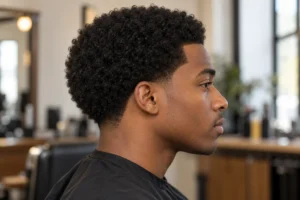 Low Taper Fade for Black Men: Styles, Line-Ups and What to Ask For
 Low Taper Fade with Textured Fringe: Styles, Barber Script and Styling
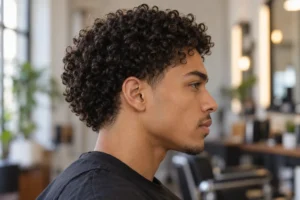 Taper Fade for Curly Hair: Low, Mid and Blowout Tapers by Curl Type
One Comment