
Fade vs Undercut: Key Differences & Which to Choose
On this page
- Fade vs Undercut at a Glance
- What Is a Fade?
- What Is an Undercut?
- Can You Have an Undercut and a Fade Together?
- Undercut vs Low, Mid and High Fade
- Which Is Better for Fine, Thin or Thick Hair?
- Do Face-Shape Rules Decide the Winner?
- Maintenance: Separate Daily Styling from Barber Upkeep
- What to Tell Your Barber
- Professional References
Fade vs undercut is not simply “blended haircut versus unblended haircut.” A fade describes a gradual change in length through the shorter section of a haircut. An undercut describes a long-top, short-side structure where the top is intentionally separated from the shorter hair below. A disconnected undercut has a hard boundary at that transition, while an undercut fade can still use a fade through the sides underneath the longer top.
Quick answer: choose a fade when you want the side and back lengths to transition gradually and connect naturally with the rest of the haircut. Choose an undercut when you want stronger contrast between a longer top and much shorter sides. If you like both ideas, ask for an undercut with faded sides and show a reference photo so the barber knows where you want the disconnection to remain.

Fade vs Undercut at a Glance
| Feature | Fade | Undercut |
|---|---|---|
| Core idea | Gradual transition between shorter and longer lengths | Longer top kept visually separate from much shorter sides/back |
| Top connection | Usually blended or graduated into the upper section | Can be softly connected or deliberately disconnected depending on the variation |
| Side section | Can be low, mid, high, drop, burst, taper or skin/zero/shadow finished | Can be one short length or can itself be faded |
| Daily styling | Depends mostly on the top style | Often needs deliberate styling if the top is kept long |
| Barber upkeep | Very crisp fades show regrowth quickly | Short sides and a sharp disconnection also show regrowth quickly |
| Best reason to choose it | You want a smooth transition and flexible silhouette | You want strong long-top/short-side contrast |
What Is a Fade?
A fade is a graduation technique: the hair becomes progressively shorter through the side or back section instead of jumping from one length to another. In GQ’s 2026 guide, professional barbers describe the key variable as where the graduation begins and how much contrast the client wants. That is why low, mid and high fades can look very different even though they use the same basic blending idea.
A fade also does not have to end at bare skin. The shortest length can be a shadow, a zero/very tight clipper finish, or skin depending on the desired contrast. For the larger family of shapes and finishes, see our fade haircuts for men guide.
What Is an Undercut?
An undercut keeps the top visibly longer than the hair below it. The classic disconnected version creates an abrupt boundary near the upper sides rather than blending the top smoothly into the short section. This produces the strong “long top over short sides” silhouette most people picture when they hear the word undercut.
The important nuance is that not every undercut has completely uniform sides. Wahl’s professional disconnected-undercut tutorial uses fade work below the disconnection line, and Andis teaches disconnected fades as a barbering variation. In other words, the short side section can be graduated while the long top remains intentionally separated.
Can You Have an Undercut and a Fade Together?
Yes. This is the point many comparison pages oversimplify. An undercut fade combines two decisions:
- Undercut structure: the longer top remains visually distinct from the shorter section below.
- Fade technique: the shorter side/back section graduates from tighter to longer instead of staying one uniform clipper length.
If you want this hybrid, do not rely on the phrase alone. Tell the barber where you want the long top to stop, how much separation you want at that boundary, and how low or high the fade should sit underneath it.
Undercut vs Low, Mid and High Fade
A classic undercut cuts the sides one length and leaves a clear line under the longer top. A fade blends from short to long instead, and its height changes how much of the side is short.
| Comparison | The main difference |
|---|---|
| Undercut vs low fade | A low fade keeps most of the side and blends near the ears and neckline; an undercut makes the whole side one short length |
| Undercut vs mid fade | A mid fade blends at mid height; an undercut has no blend, just the line under the top |
| Undercut vs high fade | Both make most of the side short; the high fade blends up into the top, the undercut stops at a clear line |
| Undercut vs taper fade | A taper only touches the sideburn and nape, so it is the most conservative of all |
Which Is Better for Fine, Thin or Thick Hair?
Hair density changes how the contrast reads, but there is no rule that automatically bans either haircut.
- Fine or lower-density hair: a very severe undercut can make the difference between a sparse top and exposed sides more obvious. A softer fade or a less aggressive undercut often creates an easier transition.
- Thick hair: an undercut can remove a lot of side bulk while leaving styling length on top. A fade can also control side weight, but the barber may need to debulk above the fade so the haircut does not mushroom.
- Curly or coily hair: both can work. The useful question is whether you want to preserve a fuller side connection or create a much stronger top-to-side separation.
- Straight or wavy hair: an undercut makes a slick-back, side sweep or longer textured top more dramatic; a fade generally creates a smoother transition into crops, quiffs and shorter top styles.
Do Face-Shape Rules Decide the Winner?
Not reliably. Competitor guides often assign specific face shapes to one cut or the other, but professional barber advice is more individualized. Head shape, hair density, recession, cowlicks, top length and styling habits all affect the result. Use face shape as one input, not as a rigid formula.
If you are unsure how much contrast to choose, use the Fade Calculator as a starting point, then show your barber a side-profile reference.
Maintenance: Separate Daily Styling from Barber Upkeep
“Which is lower maintenance?” has two different answers because daily styling and barber maintenance are not the same thing.
| Maintenance question | Fade | Undercut |
|---|---|---|
| Daily styling | Mostly depends on the top; a short crop can be nearly wash-and-go | Often higher if the top is long enough to sweep, slick or shape |
| Keeping sides crisp | Tight fades lose contrast as short hair grows | Short sides and the disconnection line also soften with regrowth |
| Grow-out tolerance | A softer shadow/low fade can grow out more gently than a very tight skin fade | A less severe undercut can grow out reasonably; a dramatic disconnect becomes obvious sooner |
GQ’s barber interviews have commonly placed tight fade maintenance around every 2–3 weeks for people who want the blend to stay very sharp. A disconnected undercut can also need frequent side cleanup, while the longer top may be trimmed on a slower schedule. Your own growth rate and tolerance for a softer grow-out matter more than a universal calendar.
What to Tell Your Barber
For a connected fade: “I want a gradual blend through the sides with no hard shelf into the top. Keep the fade [low/mid/high] and finish it [shadow/zero/skin].”
For a disconnected undercut: “Keep the top long and clearly separate it from the short sides. I want a visible disconnection at the upper sides; underneath, keep the sides around [your preferred guard or length].”
For an undercut fade: “Keep the long top disconnected, but fade the shorter side section underneath it. Do not blend the long top into the fade.”
For a different kind of contrast decision, compare burst fade vs taper fade and mid taper vs low taper.
Professional References
For current fade terminology, see GQ’s 2026 fade guide with professional barbers. For the hybrid/disconnected technique, compare Wahl’s disconnected undercut tutorial and Andis education on the disconnected fade.
What is the main difference between a fade and an undercut?
A fade describes a gradual change in length. An undercut describes a long-top, short-side structure where the top is kept visually distinct from the shorter section below.
Can an undercut have a fade?
Yes. An undercut fade keeps the longer top separated while the shorter side section is itself graduated from tight to longer lengths.
Is a fade lower maintenance than an undercut?
Not automatically. A fade may need frequent barber touch-ups to stay crisp, while a long undercut may need more daily styling. The lower-maintenance choice depends on how tight the sides are, how long the top is and how polished you want the grow-out to look.
Is an undercut bad for thin hair?
No, but a very severe contrast can make lower density on top more noticeable. A softer undercut or a connected fade may be easier to balance if coverage is limited.
Should I bring a photo to the barber?
Yes. “Fade,” “undercut” and “undercut fade” can be interpreted differently between shops. A clear side and back reference lets the barber match the height, disconnection and shortest length you actually want.
 Fade vs Taper: Differences, Photos & Barber Scripts
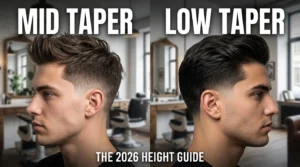 Mid Taper vs Low Taper: Differences, Height & Which to Choose
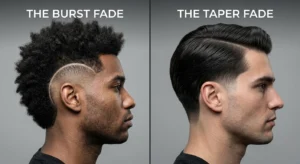 Burst Fade vs Taper Fade: Differences, Maintenance & Which to Choose
One Comment