
Korean Hairstyles for Men: 8 Looks and Barber Requests
On this page
- Compare the eight looks
- 1. Two-block haircut
- 2. Comma fringe
- 3. Middle-part curtains
- 4. See-through fringe
- 5. Side-swept fringe
- 6. Leaf-style medium layers
- 7. Rounded bowl-inspired cut
- 8. Wolf-inspired layered shag
- Do you need a Korean perm or a down perm?
- Choose by your routine, not a rigid face-shape rule
- Questions to settle before the cut
- Frequently asked questions
Korean hairstyles for men cover several different decisions: the underlying cut, the way the fringe is arranged and whether the hair is styled or chemically treated. A two-block cut can be worn with curtains or a comma fringe. Those names are useful starting points, but they do not specify every length or guarantee the same result in every salon.
Start here: choose how much forehead you want covered, whether the sides should be noticeably shorter than the top, and whether you want to keep length at the nape. Then choose the reference below that shows those details. Discuss your own density, growth direction and styling routine with your stylist.
Compare the eight looks
These are eight visual options, not eight mutually exclusive haircut categories. The same base cut can support more than one fringe arrangement. “Korean-inspired” describes the styling reference here; it is not a rule about who can wear it or what hair texture someone has.
- Two-block: longer top over shorter sides.
- Comma fringe: an asymmetric curved front lock.
- Middle-part curtains: two sections framing an open forehead.
- See-through fringe: light coverage with visible gaps.
- Side-swept fringe: diagonal forehead coverage.
- Leaf-style layers: longer, outward-moving side layers.
- Rounded bowl-inspired cut: a continuous curved perimeter.
- Wolf-inspired shag: shorter upper layers and a longer nape.
1. Two-block haircut

The reference shows a substantial top section sitting over shorter side hair. That difference in length is the useful feature to point out. Decide whether you want an obvious separation or a softer connection, and how much of the ear should remain exposed. The side does not have to be shaved to skin.
Ask your stylist: “Keep the top visibly longer than the sides, with this amount of forward fringe. Show me where the shorter section will stop before you cut.” Agree the shortest side length separately; a fixed guard number will not reproduce the whole silhouette.
Routine to consider: the longer top needs a chosen drying direction. If it lies over a cowlick, ask to see the shape after drying. MIIN’s two-block guide also describes different lengths and styling combinations rather than one compulsory finish.
2. Comma fringe

In this illustration, the front opens off-center and one lock bends inward over the forehead. That hook is what distinguishes the reference from an ordinary side sweep. Keep enough front length for the curve, while agreeing how much forehead should stay visible.
Ask your stylist: “I want this curved front section, with an opening here rather than a straight fringe. Can you show me how to dry and arrange it on my hair?”
Routine to consider: this is a styled shape, not evidence of a perm. MIIN describes a comma fringe as a curved styling arrangement; a chemical service is optional. If you dislike shaping the fringe each morning, discuss a less structured version before choosing it.
3. Middle-part curtains

The center opening separates two longer front sections. Here they curve toward the temples, with fuller sides instead of a high fade. Check the part position, the shortest front pieces and the side profile rather than asking only for “curtains.”
Ask your stylist: “Keep enough length for the front to fall on both sides of this part. I want this amount of forehead visible and a soft connection around the ears.”
Routine to consider: a strong natural part may sit slightly off-center. A small adjustment can be more practical than forcing an exact central line every day. The length shown is a reference, not a required measurement for every head.
4. See-through fringe

This example has narrow, separated pieces with forehead visible between them. It gives light coverage instead of the dense edge in the bowl-inspired reference. The effect depends on the amount of hair left at the front as well as how the pieces are arranged.
Ask your stylist: “I want light, separated coverage like this, but please check my front density before removing weight.” Fine or sparse front hair should not automatically be thinned to imitate an illustration.
Routine to consider: agree the dry fringe length, particularly if it approaches your eyes or glasses. If you prefer a stronger separated edge, compare the broader textured fringe guide.
5. Side-swept fringe

The fringe travels diagonally across the forehead, leaving one side more open. Unlike the comma example, its main feature is direction rather than a curled hook. The reference also keeps the side hair comparatively compact.
Ask your stylist: “Leave enough length to sweep the front this way and keep this amount of coverage. Please check which direction my hair naturally falls.”
Routine to consider: test the sweep with your usual glasses and after moving your head. If the front repeatedly falls into your eyes, change the length or direction rather than relying on more product to hold an unsuitable shape.
6. Leaf-style medium layers

This reference shows longer side pieces that sweep outward around the cheek and ear, with movement continuing toward the nape. “Leaf” terminology varies between salons, so use the visible layering and outline to explain the request.
Ask your stylist: “Keep these longer side layers and outward movement. Which parts can my natural texture reproduce, and which would need styling?”
Routine to consider: distinguish a layered cut from a “leaf perm.” An illustration of curved hair cannot tell you how it was produced. If you prefer a fuller, more connected outline, compare the Mod Cut guide before deciding how much layering to request.
7. Rounded bowl-inspired cut

The dense fringe connects visually with a rounded side outline. This is deliberately fuller than the see-through fringe. The shape depends on where the perimeter sits around the brows and ears, so check both the front and side before shortening it.
Ask your stylist: “Keep a rounded outline like this, with the front at this height and this amount of ear coverage. I want a softened edge rather than a ruler-straight line.”
Routine to consider: discuss how the perimeter will look as it grows. If your hair naturally bends or curls, the dry outline may differ from this straight-haired reference; adapting it is preferable to assuming it must be straightened.
8. Wolf-inspired layered shag
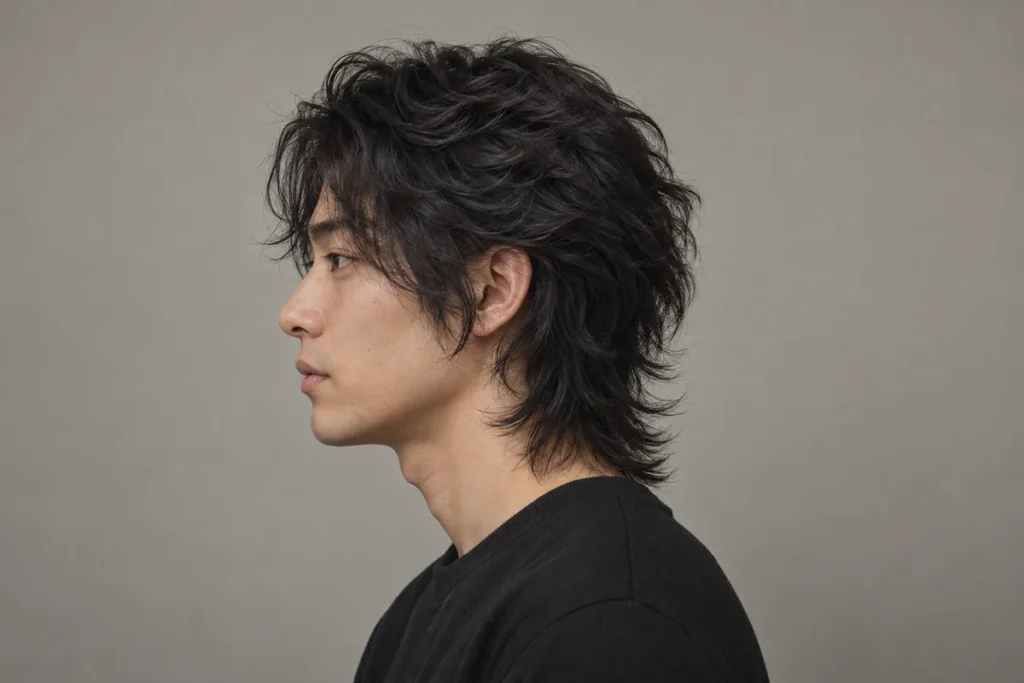
The side view shows shorter, broken-up upper layers with visibly longer hair at the nape. It has a different structure from the compact two-block example. “Wolf cut,” “shag” and “mullet” can overlap in salon vocabulary, but they should not be treated as identical requests.
Ask your stylist: “Keep this rear length and these shorter upper layers. I want movement around the ears without shaving away the sides.” Point to the maximum rear length you are comfortable maintaining.
Routine to consider: evaluate the back as carefully as the front. If you want a shorter nape, say so before layering begins. Do not request a burst fade unless you actually want a separate faded area around the ear.
Do you need a Korean perm or a down perm?
Not every Korean-inspired hairstyle requires a perm. First decide on the cut and try a styling approach compatible with your natural texture. If you are considering a chemical service, discuss the intended change, previous colour or chemical processing, and maintenance with the professional performing it.
A down perm is different from adding curls through the top. It commonly addresses hair projecting outward on the sides and sometimes the back. It is not a universal top-only treatment or an automatic recommendation for curly hair. See Zoltan Hair’s explanation of down-perm placement. This guide does not provide chemical application instructions.
Choose by your routine, not a rigid face-shape rule
- Prefer forehead coverage? Compare the side sweep, wispy fringe and rounded fringe; they provide visibly different amounts of coverage.
- Prefer an open front? Start with curtains or a comma arrangement and agree the part position.
- Want a compact side profile? Consider the two-block reference, then specify the side length.
- Want longer movement? Compare the leaf-style layers and shag, especially the rear length.
Face shape can inform a preference for height, width or coverage, but it does not make one haircut mandatory. Bring a current photo of your own hair and describe how you wear it on an ordinary day. A reference with similar texture and density is usually a clearer discussion aid than one chosen only because the model looks like you.
Questions to settle before the cut
- Where should the fringe finish when dry?
- How short should the sides be, and should the top connect or overhang?
- How much length should remain around the ears and at the nape?
- What does the shape look like without salon styling?
- Which part will need attention first as it grows?
Frequently asked questions
Is a two-block haircut the same as an undercut?
They can share a short-side, long-top contrast, but the names do not specify the same connection in every shop. Show the separation you want and compare the fade versus undercut guide for that structural decision.
Can I wear these styles without a perm?
Yes, some versions may work with your natural texture and ordinary styling. A reference image cannot determine whether your own hair needs a treatment. Ask for a cut-and-styling consultation first.
Are these haircuts only for Korean men?
No. The description refers to a style influence. Suitability depends on the individual hair, desired shape and routine, not ethnicity.
How often should I get a trim?
Agree a schedule based on the fringe and side lengths you choose and how much grow-out you like. Refreshing the fringe or perimeter may be a different appointment from reshaping longer layers.
Editorial note: researched by Burst & Taper. Salon sources inform terminology; examples and barber-request wording are editorial suggestions, not a professional assessment of your hair.
 Buzz Cut Guard Sizes: Every Length From #0 to #16, With Photos
 Two Block Haircut: 5 Styles, Lengths & Barber Tips
 Wolf Cut for Men: 6 Layered Styles & Barber Requests
2 Comments