
Haircut Numbers & Clipper Guard Sizes: #½–#8 Chart
On this page
- Clipper Guard Sizes and Haircut Numbers Chart
- What Does “Number 1 Haircut” Mean?
- Is No Guard the Same as a #0?
- What the Taper Lever Changes
- Which Guard Should You Choose?
- Haircut Numbers by Hair Texture
- How Haircut Numbers Relate to Fades and Tapers
- What to Tell Your Barber
- Common Clipper Guard Mistakes
- Source and Measurement Note
- Frequently Asked Questions
- Use haircut numbers alongside placement references
Clipper guard sizes tell you approximately how much hair a guide comb leaves when used correctly. In the common Wahl-style sequence, higher numbers leave longer hair: #1 is 1/8 inch, #4 is 1/2 inch and #8 is 1 inch. But guard sets, blade positions and brand labeling vary, so always verify the number and length printed on the actual attachment.
Planning a one-length cut? See buzz cut guard sizes for photos of every length from #0 to #16 and how often to re-buzz.
Quick answer: #½ = 1/16″, #1 = 1/8″, #2 = 1/4″, #3 = 3/8″, #4 = 1/2″, #5 = 5/8″, #6 = 3/4″, #7 = 7/8″ and #8 = 1″. These are standard reference lengths, not a guarantee that every brand, blade or lever position cuts identically.

Clipper Guard Sizes and Haircut Numbers Chart
| Guard number | Length in inches | Approx. millimeters | Common use |
|---|---|---|---|
| #½ | 1/16″ | 1.5 mm | Very short base/blending step |
| #1 | 1/8″ | 3 mm | Short buzz or lower fade section |
| #2 | 1/4″ | 6 mm | Traditional short buzz; darker than #1 |
| #3 | 3/8″ | 10 mm | Longer buzz or transition length |
| #4 | 1/2″ | 13 mm | Brush/crew-cut territory; fuller sides |
| #5 | 5/8″ | 16 mm | Short styleable length |
| #6 | 3/4″ | 19 mm | Longer clipper-cut top or sides |
| #7 | 7/8″ | 22 mm | Long clipper length with styling flexibility |
| #8 | 1″ | 25 mm | Longest common numbered guide in many sets |
The inch values above match Wahl’s published guide-comb chart. Metric values are rounded practical equivalents. A manufacturer may print 6 mm or 6.5 mm for a nominal 1/4-inch attachment, so the physical label takes priority.
What Does “Number 1 Haircut” Mean?
When someone asks for a “number 1,” they usually mean a #1 guide comb, which is commonly listed as 1/8 inch or about 3 mm. That does not fully describe a haircut. The barber still needs to know where to use that guard, whether the lever is open or closed, what length belongs on top, and whether the edges should be natural or sharply lined.
For example, “#1 on the sides” can mean one uniform length, a #1 used only at the lower section of a fade, or a #1 blended upward into a longer guard. Show the desired shape as well as saying the number.
Is No Guard the Same as a #0?
Not reliably. “No guard,” “zero” and “#0” are used differently across brands and barbershops. Blade length also changes with an adjustable taper lever. Some sets include guards below #1—such as #½—and other systems use different numbering. Say whether you want visible stubble, an extremely close clipper finish or bare skin instead of assuming one universal zero measurement.
What the Taper Lever Changes
On an adjustable clipper, the lever changes blade position between closer and longer settings. Wahl explains that moving the lever can adjust closeness between guard lengths. The exact cut length depends on the clipper, blade, guard and lever position, so “#2 open” should not be treated as a universal millimeter measurement across every tool.
- Lever closed: generally cuts closer.
- Lever open: generally leaves slightly more length.
- Half positions: help a barber erase visible lines between guards.
This is one reason a clean fade cannot be reduced to a list of guards. Technique, head shape, hair growth direction and the rocking-out motion all influence the transition.
Which Guard Should You Choose?
| Goal | Useful starting reference | What to confirm |
|---|---|---|
| Very short buzz | #1–#2 | Scalp visibility and uniform vs faded sides |
| Longer buzz | #3 | Whether edges/sides should be shorter |
| Brush or short crew shape | #4 around selected areas | Top may need scissors or a longer guard |
| Styleable clipper length | #5–#8 | Texture, growth direction and final silhouette |
| Fade transition | Multiple guards plus lever work | Fade height and shortest finish |
These are communication references, not fixed haircut recipes. A #4 on tightly coiled hair may look different from a #4 on straight fine hair because of shrinkage, density and how hair stands from the scalp.
Haircut Numbers by Hair Texture
- Straight hair: guard length is easy to see, and uneven passes can be obvious.
- Wavy hair: the measured cut length may appear shorter or longer depending on bend and direction.
- Curly/coily hair: shrinkage and compression under the guard affect the visible result. A dry reference photo with a similar curl pattern is more useful than a number alone.
- Fine or thinning hair: shorter guards can increase scalp visibility, so start longer when unsure.
- Very dense hair: clippers may need slower, overlapping passes; guard number still does not replace blending and shape decisions.
How Haircut Numbers Relate to Fades and Tapers
A fade or taper uses multiple lengths rather than one number everywhere. The stylist creates a transition from a shorter base into longer hair. For the shape distinction, see fade vs taper. For height and style families, use the fade haircuts for men guide. If you are deciding what placement to request, use the Fade Calculator.
What to Tell Your Barber
“I want approximately [guard number/printed length] on [specific area], blended into [longer length/top]. Keep the fade/taper [low/mid/high or localized], finish the bottom at [shadow/zero/skin], and show me the first section before taking it shorter.”
If you do not know the number, show a photo and say whether you want visible scalp, short stubble or fuller coverage. A barber can translate the visual goal into the right guard/blade sequence for your hair.
Common Clipper Guard Mistakes
- Assuming every brand’s #0 or half guard means the same length.
- Giving one number without saying where it should be used.
- Forgetting that lever position changes the effective cutting length.
- Starting shorter instead of beginning conservatively and checking.
- Expecting the same visible result across different textures and densities.
- Confusing a guard length with a complete fade or taper design.
Source and Measurement Note
Measurements in this guide use the published standard Wahl sequence and rounded metric equivalents. Always check the marking on your own guide comb and the instructions for your clipper.
Frequently Asked Questions
What are the standard clipper guard sizes?
The common sequence is #½ at 1/16 inch, #1 at 1/8, #2 at 1/4, #3 at 3/8, #4 at 1/2, #5 at 5/8, #6 at 3/4, #7 at 7/8 and #8 at 1 inch. Verify your own brand’s labels.
What length is a number 2 haircut?
A standard #2 guard is commonly listed as 1/4 inch, approximately 6 mm. The final look also depends on hair texture, direction and where the guard is used.
What length is a number 4 haircut?
A standard #4 guard is commonly 1/2 inch, approximately 13 mm. It leaves enough coverage for many brush-cut or short crew-style shapes.
Is a number 0 haircut bald?
Not necessarily. Zero terminology varies. No-guard clipper work usually leaves very short stubble, while a skin/bald finish removes hair at the base. Confirm the actual desired finish.
Does opening the lever make hair longer?
Generally yes on an adjustable clipper: an open lever leaves slightly more length than a closed lever. The exact difference varies by clipper and blade.
Use haircut numbers alongside placement references
The existing chart gives nominal guide-comb lengths. The diagrams below explain the information a number leaves out. These are original editorial diagrams, not AI-generated haircut photos or technical diagrams of a particular clipper.
Length, placement and top shape are three separate choices
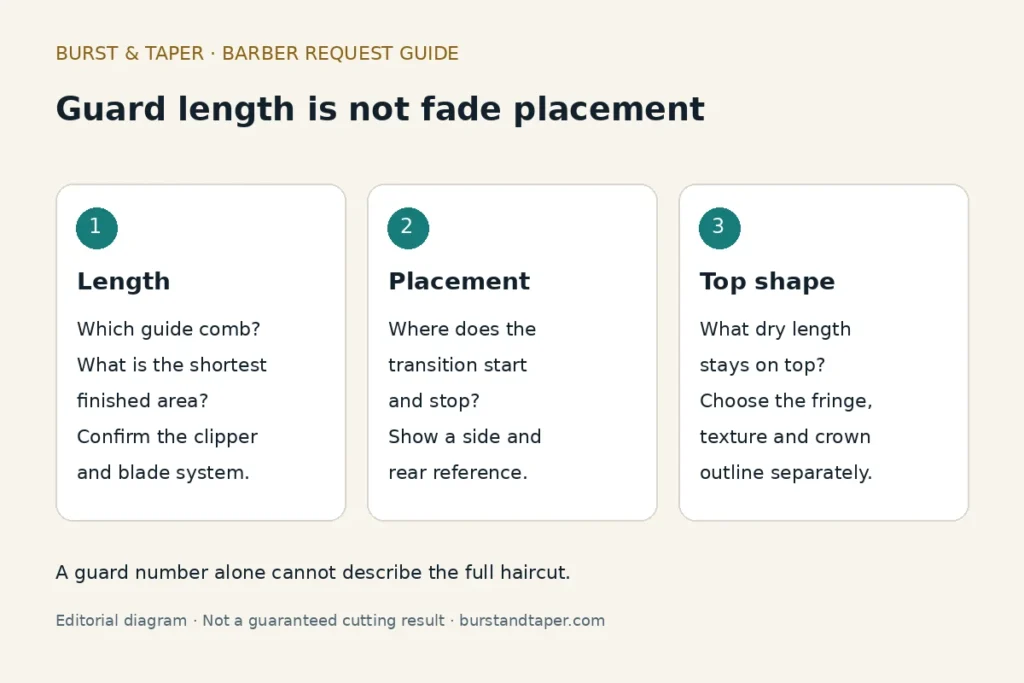
“Number two” does not say whether that length is on the top, the shortest part of a taper, or an area above a skin finish. State the area you mean. Then show where the transition should begin and where the longer hair should remain. This prevents the guard number from being mistaken for the height of a fade.
Check the clipper system and finished result
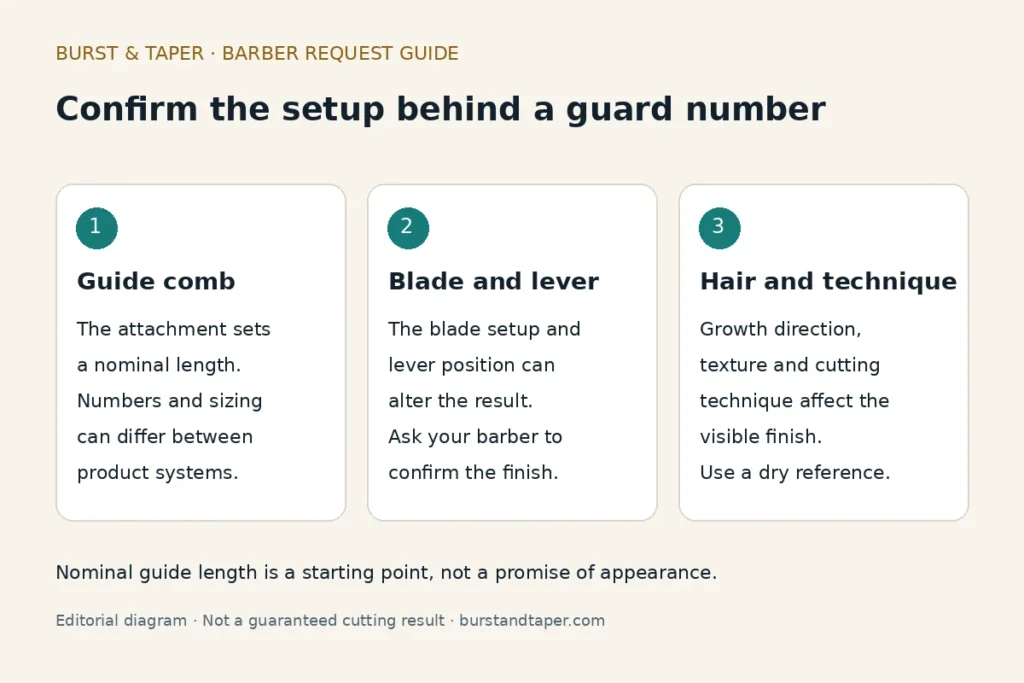
Manufacturer charts describe their own guide system. Confirm the guide, blade and lever setup instead of assuming that every clipper marked with the same number behaves identically. Hair direction and technique also affect the visible result; a diagram cannot establish a precise finished length from a photo.
Barber request: “Use this nominal length in this area, keep this much top length when dry, and start the transition here. Please confirm the clipper setup and show me the shortest finish before going closer.”
For the published length reference, see Wahl’s guide-comb chart. For placement, compare fade vs taper and mid taper choices.
 Buzz Cut Guard Sizes: Every Length From #0 to #16, With Photos
 Two Block Haircut: 5 Styles, Lengths & Barber Tips
 Wolf Cut for Men: 6 Layered Styles & Barber Requests
One Comment