
Fade Haircuts for Black Men: 6 Best Types & Complete Guide
On this page
- Fade Haircuts for Black Men: Start With Placement
- Types of Fades and Tapers for Black Men: 6 Popular Options
- Choose Shadow, Zero or Skin Separately
- Natural Hairline Guidance for Fade Haircuts for Black Men
- Match the Top to Your Real Texture
- Exact Barber Request
- Maintenance Without a Universal Schedule
- Sources and Further Reading
- Frequently Asked Questions
Fade haircuts for Black men include far more than one skin-fade template. A useful choice starts with four separate decisions: where the graduation travels, how short it finishes, how much side and back weight remains, and how the top works with your actual texture and routine. Black men can have straight, wavy, curly or coily hair, so ethnicity alone should never be treated as a haircut rule.
Quick answer: choose a low taper for the most retained side weight, a temple fade for front-side detail, a burst fade for an ear-centered arc, a drop fade for a connected band that descends behind the ear, or a full low/mid/high fade for broader side and back coverage. Then choose shadow, zero or skin separately and tell the barber to respect your natural hairline.
Want the lightest, most popular option? See the full guide to the low taper fade for Black men, with waves, twists, sponge curls, locs and afro styles. For a high-contrast look with a shaped top, see the Boosie fade.

Fade Haircuts for Black Men: Start With Placement
| Cut family | Where the shortest work concentrates | Useful when you want |
|---|---|---|
| Low taper | Temple/sideburn and nape close to the perimeter | A clean outline with maximum retained side weight |
| Temple fade / temp fade | Primarily the temple and sideburn | A localized front-side detail that can connect to a beard |
| Burst fade | Rounded arc centered around the ear | Contrast around the ear with curls, a faux hawk, mohawk or mullet shape |
| Drop fade | Connected band that descends behind the ear | A fade that follows the rear curve of the head |
| Low, mid or high fade | Broader connected band through the sides and back | Increasingly visible all-around contrast |
The best fade haircuts for Black men match placement and retained weight to the individual rather than copying a trend label. These terms vary between shops. Show a clear side and rear reference and point to the intended high point. Our fade vs taper guide explains broad versus localized coverage, while burst fade vs drop fade isolates the difference between an ear arc and a descending rear path.
Types of Fades and Tapers for Black Men: 6 Popular Options
Two of the six are tapers that only blend the edges (the low taper and the high taper), the temple fade stays at the hairline, and the burst, drop and mid fades take more off the sides. Start with how much side coverage you want to keep, then pick the shape.These six fade haircuts for Black men cover different placement and coverage choices; none is automatically correct for every texture, density or routine.
Low taper with waves
A low taper can clean the temple and nape while leaving most of the wave pattern intact. Ask the barber to keep the taper narrow, brush the waves in their normal direction before the cut and avoid taking the lineup behind the established natural edge.
Temple fade with curls or a short afro
A temple fade adds definition around the sideburn without removing a full band through the sides. It can work with a rounded short afro, sponge curls or a longer curly top. Decide whether the beard should connect continuously or remain separated.
Burst fade with coils, faux hawk or mohawk
The rounded arc focuses attention around the ear and can preserve a center strip or longer rear. This is useful when the top/back silhouette matters more than all-around exposure. Specify the arc width and rear length; do not assume the word “burst” settles those details. See burst fade haircut types and the corrected coily faux-hawk guide.
Drop fade with twists
A drop fade can follow the head shape beneath short twists while preserving more visual depth near the rear crown than a level fade. The barber should establish the twist section first, then decide how the descending path connects underneath it. The established burst fade vs drop fade comparison shows how the rear path differs from an ear-centered burst.
Mid fade with a compact coily top
A mid fade removes a broader band than a taper and creates clearer all-around separation. It suits someone who wants a sharper side profile and accepts more visible grow-out. Keep the top outline based on actual density rather than forcing a perfectly geometric shape onto uneven growth.
High taper with a fuller top
A high taper makes the temple and nape cleanup stronger while retaining more middle-side weight than a full high fade. It can support a curly top, short twists, waves or a textured crop. For more placement examples and barber requests, see our high taper fade guide.
Choose Shadow, Zero or Skin Separately
| Finish | What remains at the base | Trade-off |
|---|---|---|
| Shadow | Visible short hair | Softer contrast and generally less abrupt grow-out |
| Zero | Very tight clipper stubble | Crisp contrast without automatically meaning bare skin |
| Skin / bald | Hair removed at the lowest point | Maximum contrast and the quickest visible return of stubble |
For fade haircuts for Black men, scalp comfort and individual shaving response matter more than a maximum-contrast trend. If close shaving causes bumps or irritation, tell the barber and choose a longer finish rather than treating bare skin as a requirement. Persistent or painful scalp problems should be assessed by a qualified healthcare professional.
Natural Hairline Guidance for Fade Haircuts for Black Men
A crisp lineup should refine the existing edge, not invent a new one far behind it. Ask the barber to show the intended line before removing hair, especially at the corners. Temporary sprays, fibers or enhancements can change how a fresh cut photographs; ask whether they are being used if you want to judge the haircut itself.
- Bring a reference with a hairline and density reasonably similar to yours.
- Say whether you want a natural edge, a softly cleaned edge or a sharp lineup.
- Point out scars, sensitive areas, cowlicks or thin spots before cutting.
- Do not ask the barber to copy an enhancement-heavy photo as though every visible line is natural hair.
Match the Top to Your Real Texture
| Top | Main decision | Useful preparation |
|---|---|---|
| Waves | How much wave area the taper may remove | Brush in the established pattern and bring your normal wave cap routine |
| Short curls/coils | Dry height, shrinkage and edge softness | Show the barber the hair in its normal dry state |
| Short afro | Rounded, squared or natural silhouette | Agree on overall height before the perimeter is sharpened |
| Twists or locs | Section placement and how the fade connects underneath | Confirm which rows must remain and avoid tension at the edge |
| Textured crop | Forward length and connection at the corners | Choose separated texture versus a solid blunt edge |
The American Academy of Dermatology recommends gentle practices for curly/coily hair, including avoiding unnecessary tension and handling hair carefully. A haircut guide cannot diagnose breakage or hair loss, but it can avoid presenting tight styling or aggressive edge work as universally harmless.
Exact Barber Request
When discussing fade haircuts for Black men, a precise placement-and-finish request is more useful than asking for a demographic label alone.
“I want a [low taper / temple / burst / drop / low-mid-high fade]. Put the shortest area [point to placement], finish it at [shadow / zero / skin], keep [amount] of weight around the sides and back, and keep the top [style and length]. Please follow my natural hairline without pushing the corners back. I brought a side and rear reference for the shape.”
If you are still deciding, use the Fade Calculator to organize contrast, placement, texture and maintenance preferences before the appointment.
Maintenance Without a Universal Schedule
Maintenance for fade haircuts for Black men depends on the selected finish, edge treatment, texture, growth rate and routine. A skin finish and sharp lineup show growth sooner than a shadow finish and natural edge. Waves, twists, coils and free-form tops also have different daily routines. Rebook when the silhouette or edge no longer matches your preference; there is no evidence-based rule that every person needs the same fixed interval.
- Keep the scalp clean with products that suit your skin and routine.
- Use appropriate moisture for curls/coils without overloading the scalp.
- Limit unnecessary tension at the temples and edges.
- Use a durag or wave cap based on your wave routine, not as a substitute for scalp care.
- Seek professional medical advice for persistent itching, pain, scaling, bumps or sudden hair loss.
Sources and Further Reading
- American Academy of Dermatology — dermatologist tips for curly and coily hair
- Modern Barber — professional explanation of taper and fade placement
- GQ — fade height, finish and barber-communication guidance
Frequently Asked Questions
What are the best fade haircuts for Black men?
There is no single best cut based on ethnicity. Low tapers, temple fades, burst fades, drop fades and full low/mid/high fades can all work. Choose based on your texture, density, desired coverage, scalp comfort, top style and maintenance preference.
Which fade works well with waves?
A low taper or temple fade preserves the most wave area, while a full fade removes more side coverage. Tell the barber how much of the established wave pattern must remain.
Does a fade have to go to skin?
No. Shadow, zero and skin are separate shortest-finish choices. Any placement can usually be adapted to a softer or tighter finish.
How do I stop a barber pushing my hairline back?
Ask the barber to follow your natural edge, show the proposed line before cutting and avoid using a reference whose visible edge depends heavily on enhancement products.
What pictures should I bring?
Bring a side view for placement, a rear view for the neckline/path and a top reference with texture and density reasonably similar to yours.
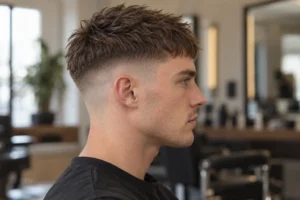 Textured Crop Haircut: Styles, Fades and How to Ask Your Barber
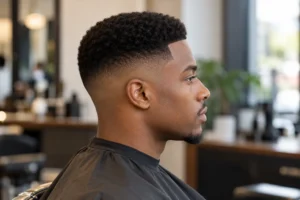 Boosie Fade: What It Is, 7 Styles and How to Ask for It
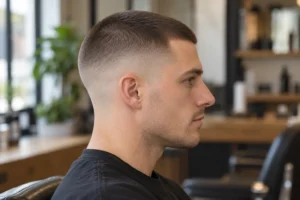 Buzz Cut Fade: Low, Mid, High and Skin Fade Styles With Photos
2 Comments