
Best Fade for a Receding Hairline: Options & What to Avoid
On this page
- First: A Fade Changes Appearance, Not Hair Growth
- How to Choose the Best Fade for a Receding Hairline
- Strategy 1: Preserve More Side Weight
- Strategy 2: Use Texture or a Forward Fringe
- Strategy 3: Reduce the Contrast Everywhere
- When a High or Skin Fade Helps—and When It Doesn’t
- Styles That Often Work Better Than Slicking Straight Back
- What to Tell Your Barber
- When to Ask a Dermatologist Instead of a Barber
- Sources and Further Reading
- Frequently Asked Questions
A haircut cannot stop a receding hairline, but it can change the visual balance between the hairline, sides and top. The best fade for a receding hairline depends on how much density you have on top, where recession is happening, and whether you want to preserve side weight or create stronger contrast; there is no single best choice for everyone.
Quick answer: the best fade for a receding hairline is the one that manages contrast around your actual density rather than following a universal rule. A low taper or low fade is the safer subtle starting point when you want to keep more side weight. A mid fade can create balanced contrast with a textured top. A high or skin fade can redirect attention upward on some heads, but on others it exposes the temple corners more clearly. A close crop or buzz cut reduces the length contrast everywhere (see buzz cut guard sizes to choose the length).

First: A Fade Changes Appearance, Not Hair Growth
Male-pattern hair loss commonly begins with recession above the temples and can progress gradually. A fade changes the surrounding haircut; it does not alter the biological cause of hair loss. If you are concerned about hair loss itself, especially if it is sudden, patchy, painful, itchy or progressing quickly, a dermatologist is the right person to assess the cause.
How to Choose the Best Fade for a Receding Hairline
| Option | What it does visually | Main trade-off |
|---|---|---|
| Low taper / low fade | Preserves more side density and keeps the change subtle | Does less to create dramatic top-to-side contrast |
| Mid fade | Creates a balanced frame for a textured or forward top | Temple recession becomes more exposed than with a very soft taper |
| High / skin fade | Strongly shortens the sides and can direct attention toward the top | Can also make temple corners more obvious on some people |
| Close crop / buzz | Reduces length contrast across the whole head | Offers less ability to use fringe or texture for coverage |
Strategy 1: Preserve More Side Weight
If the goal is not to spotlight the temples, the best fade for a receding hairline may be a low taper fade or a low fade. Keeping the shortest work close to the perimeter can make the overall silhouette feel less exposed than taking the sides high. This is especially useful when the top is not dramatically denser than the sides.
Strategy 2: Use Texture or a Forward Fringe
Forward movement can soften the visual outline of the hairline. A French crop fade, Caesar-style fringe or textured fringe with a taper can use short front hair to frame the forehead without requiring a comb-over. GQ’s thinning-hair guidance specifically includes Caesar and textured/faded styles among options that can help balance recession.
The Edgar haircut is another forward-fringe option, but its strong front line is a style choice rather than a concealment guarantee. If the hairline is uneven or density is low at the very front, a softer crop may be easier to adapt.
Strategy 3: Reduce the Contrast Everywhere
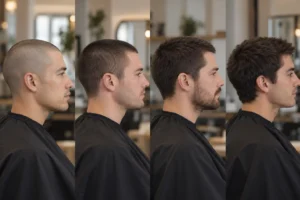
A buzz cut or close crop can work well because it stops asking the eye to compare a long dense top with thinning areas. This directly corrects a common bad rule online: uniform short hair does not automatically make recession worse. On many people, intentionally going short is one of the cleanest ways to make the hairline part of the haircut rather than something being hidden.
When a High or Skin Fade Helps—and When It Doesn’t
A high or skin fade removes a lot of side hair. When the top still has useful density, that contrast can make the top appear stronger. GQ has shown this strategy in barber demonstrations. But it is not automatically the “best” choice: if recession at the temples is the feature you most want to soften, removing all nearby side weight may expose those corners more clearly.
That is why a photo of your own hairline, viewed from the front and both temples, matters more than a generic chart.
Styles That Often Work Better Than Slicking Straight Back
- French crop or Caesar: short forward fringe can visually balance temple recession.
- Textured crop: broken texture reduces the emphasis on one hard front line.
- Short side-sweep or curtains: if density allows, movement can sit across recession points instead of exposing them directly.
- Buzz or crew cut: useful if you prefer a clean, low-styling approach rather than concealment.
Slicked-back hair is not “wrong,” but it deliberately displays the hairline. Choose it only if you are comfortable with that effect.
What to Tell Your Barber
Use this script to help your barber choose the best fade for a receding hairline without assuming one height or finish works for everyone:
“My hairline is receding at the temples. I want the cut to work with it rather than expose it more. Please show me how a low taper, mid fade and shorter crop would change the contrast before taking the sides high. I want the top [forward / textured / close-cropped], and I don’t want the temples pushed back with the lineup.”
The last sentence matters: an edge-up should respect the natural hairline. Ask the barber not to chase a perfectly straight line by removing extra hair at already-receding corners.
When to Ask a Dermatologist Instead of a Barber
A barber can help with appearance but cannot diagnose the cause of hair loss. The American Academy of Dermatology notes that hair loss can be gradual or sudden and can have multiple causes. If you notice sudden patches, rapid change, pain, itching, scaling or other scalp symptoms, get medical advice rather than assuming it is ordinary male-pattern recession.
Sources and Further Reading
- GQ — barber and stylist guidance for thinning hair and recession
- GQ — short haircut guidance including Caesar cuts for receding hairlines
- American Academy of Dermatology — causes and signs of hair loss
- MedlinePlus Genetics — androgenetic alopecia overview
Frequently Asked Questions
What is the best fade for a receding hairline?
There is no universal best fade. A low taper preserves side weight, a mid fade creates balanced contrast, and a high or skin fade can either redirect attention upward or expose the temple corners more clearly. Your density and desired contrast decide the better starting point.
Can a buzz cut work with a receding hairline?
Yes. A buzz or close crop can reduce the contrast between thicker and thinner areas and make the hairline feel intentional rather than concealed.
Can a fade make a receding hairline look worse?
It can if the placement removes side weight you wanted to keep or exposes the temple corners more than you expected. Preview the likely contrast with your barber before going very high or to skin.
Should I use a lineup on a receding hairline?
A light cleanup can look sharp, but ask the barber to respect your natural corners rather than push the line backward just to make it perfectly straight.
Can a haircut treat hair loss?
No. A haircut changes appearance only. If you want to understand or treat hair loss, speak with a qualified medical professional or dermatologist.
 Buzz Cut Guard Sizes: Every Length From #0 to #16, With Photos
 Two Block Haircut: 5 Styles, Lengths & Barber Tips
 Wolf Cut for Men: 6 Layered Styles & Barber Requests
One Comment