
Mid Taper Fade Coily Hair – The 2026 Barber Guide
On this page
- The Pinnacle of Natural Texture: The Mid Taper Fade Coily Hair Cut
- Silhouette Analysis: The Geometry of the Blend
- How to Ask Your Barber for a Mid Taper Fade Coily Hair Style
- Face Shape Compatibility: Maximizing Your Mid Taper Fade Coily Hair Profile
- The Maintenance Cycle: Preserving the Edge
- Product & Styling Guide: Hydration and Sponging
- Frequently Asked Questions
- Mid taper fade on coily hair: compare the side and neckline
The Pinnacle of Natural Texture: The Mid Taper Fade Coily Hair Cut
In the realm of modern grooming, mastering natural texture is the ultimate test of a barber’s skill. The mid taper fade coily hair combination stands as the absolute pinnacle of this craft. Unlike high skin fades that completely remove the side canvas, a mid taper acts as a structural foundation. It sharpens the perimeter of the hairline while allowing dense, natural coils to flourish on top, creating a majestic, voluminous halo that is deeply rooted in contemporary high fashion.
For looser curl types, from 2C to 3C, see the taper fade for curly hair.
If you are searching for the best mid taper fade coily hair look, what elevates this specific variation from a standard haircut to a premium architectural masterpiece is the introduction of custom geometric line-work. By combining the soft, natural curves of coily hair with razor-sharp, right-angle lineups at the temples, barbers create a striking visual dichotomy. It is the perfect balance between raw natural texture and microscopic, surgical precision.
Silhouette Analysis: The Geometry of the Blend
When styling a mid taper fade coily hair cut, we must examine the geometry. A mid taper fade strategically targets only the sideburns and the very bottom of the neckline. By initiating the fade at the midpoint of the ear, the barber preserves the critical weight line along the parietal ridge (the upper curve of the head).
If you have denser hair, our mid taper fade for thick hair guide explains how to balance the blend while keeping enough weight through the upper sides.
For anyone sporting a mid taper fade coily hair style, preserving this structural “corner” is non-negotiable. Without it, the hair will round out entirely, resulting in a bulbous, unshaped silhouette. The mid taper keeps the sides perfectly tailored and vertical, pushing all the visual volume upward. When you add a custom, stepped geometric lineup at the C-cup (the temple area), you introduce aggressive, masculine angles that frame the face with unparalleled sharpness.
How to Ask Your Barber for a Mid Taper Fade Coily Hair Style
Communication in the barber chair is the difference between an average cut and a masterpiece. When dealing with natural coils and complex lineups, clarity is mandatory.
- Step 1: The Volume Consultation. Begin by establishing the length on top. Coily hair experiences “shrinkage” when dry. Instruct your barber to gently shape the top canopy, ensuring they account for shrinkage so the final halo isn’t too short.
- Step 2: Executing the Skin Taper. Request a mid bald taper or mid skin taper. The transition from bare skin to dense coils must be microscopic and seamless, with no harsh lines visible in the gradient, which is essential for any mid taper fade coily hair design.
- Step 3: The Geometric Lineup. This is where the magic happens. Ask your barber for a razor-sharp front edge-up. If you want the custom look, request a “geometric temple cutout” or a “stepped C-cup.”
- Step 4: The Neckline Taper. The back should mirror the sideburns. The fade should begin at the bottom of the nape and blend smoothly upward, terminating right below the occipital bone to leave a heavy weight line.
Face Shape Compatibility: Maximizing Your Mid Taper Fade Coily Hair Profile
The mid taper fade coily hair aesthetic is universally flattering because it relies on the mathematical principle of adding height while maintaining structured width. Here is how it interacts with specific facial structures:
- Round Faces: This is a godsend for round faces. The tight, vertical sides break up the softness of the face, while the coily volume elongates the head perfectly.
- Square Faces: Highly recommended. The natural texture provides a great contrast to a strong, boxy jawline.
- Oval and Oblong Faces: Be cautious with the height. Keep the halo tightly shaped and rounded to maintain proportion. If you want something more aggressive, you might explore a burst fade to change the side profile entirely.
The Maintenance Cycle: Preserving the Edge
Natural coily hair requires dedication to maintain this level of perfection. To keep your mid taper fade coily hair looking fresh, you must visit the barber every 10 to 14 days for an edge-up and taper refresh.
At home, nighttime maintenance is critical. You must sleep with a silk or satin durag or bonnet. Cotton pillowcases will absorb the moisture from your coils, causing breakage, severe frizz, and destroying the curl pattern you worked so hard to build.
Product & Styling Guide: Hydration and Sponging
Coily hair does not need heavy, suffocating pomades. It needs moisture and definition. Follow this professional regimen to keep your mid taper fade coily hair style looking healthy and defined:
- The Hydration Foundation: Coils are prone to dryness. After washing, apply a premium leave-in conditioner. We highly recommend products infused with natural oils from authoritative brands like Shea Moisture or Cantu.
- The Curl Sealant: Once hydrated, apply a dime-sized amount of curl-defining cream or a lightweight styling gel. This seals the hair cuticle and prevents environmental humidity from causing unwanted frizz.
- The Sponge Technique: To achieve those perfectly defined, spiraled coils, use a specialized curl sponge. Gently rub the sponge in continuous circular motions over the top of your head.
Frequently Asked Questions
How long should my hair be for a mid taper fade coily hair cut?
For the best results, you need at least 2 to 3 inches of natural hair growth on top. This provides enough length for the coils to form a defined, voluminous shape.
What is the difference between a mid taper and a high taper on coily hair?
A high taper pushes the fade all the way up to the temples, exposing much more skin. A mid taper stops at the middle of the ear, leaving more hair on the sides to create a wider, more conservative box silhouette for your mid taper fade coily hair look.
How do I keep my geometric lineup sharp at home?
While you should leave the heavy lifting to your barber, you can use a high-quality trimmer at home to carefully clean up the stubble below the hard lines of your edge-up.
Mid taper fade on coily hair: compare the side and neckline
Visual disclosure: The new realistic references below are original AI-generated editorial illustrations of fictional adults. They illustrate haircut choices, not real client results. Compare the visible shape with your own hair and discuss adaptations with your barber.
Use these references to separate where the taper sits from how short it finishes. A mid taper concentrates the transition at the temple/sideburn and neckline while retaining more hair across the middle sides. It does not have to become a full band around the head.
Side view: retained weight with a localized taper

The dark middle side remains visible above and behind the ear. The shorter temple area blends into that retained hair, while the coiled top has a rounded outline. This is a placement reference, not a promise of a particular guard length. Ask your barber where the transition should end before deciding how close to skin the shortest area should be.
Rear view: a soft neckline under the coiled shape
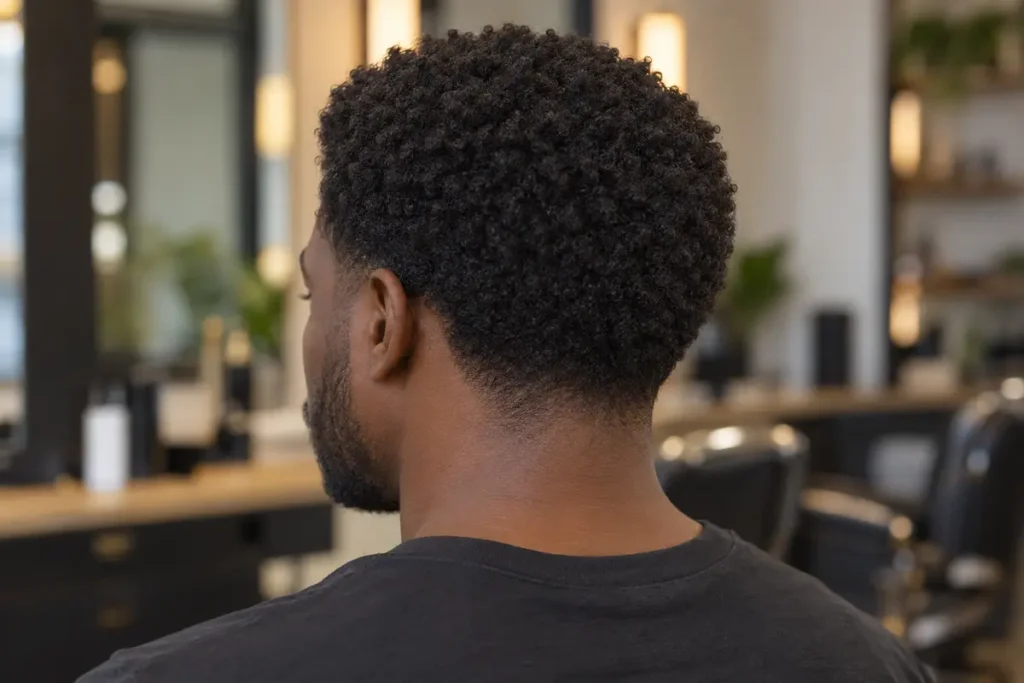
The rear reference preserves dark center-back hair above a small neckline transition. Use it to show how much back weight you want left in place. A softer short-hair finish is a legitimate choice; bare skin and a sharply carved lineup are optional. Keep the natural hairline if that is your preference.
Settle these choices before cutting
- Show your top at its usual dry length, since stretched and dry coiled hair can have different visible lengths.
- Choose the taper placement, shortest finish and top outline separately.
- Agree on natural edges or a defined lineup; do not assume an edge-up is compulsory.
- Choose a refresh schedule based on growth, budget, scalp comfort and your tolerance for softer edges.
Important clarification for the older wording above: a skin taper, rigid geometric corner and fixed 10–14-day schedule are not universal requirements. Face shape alone does not make this cut mandatory or universally flattering. Conditioning and styling needs vary; products do not guarantee the prevention of frizz or breakage.
Barber request: “Keep this dry coiled length and this much side weight. Taper only the temple and neckline to this placement. Leave the shortest area at the finish we agree on, and keep my edges natural unless I ask for a lineup.”
For the overall placement options, see the mid taper fade guide. To compare the shapes rather than top texture, see mid taper vs low taper.
 Low Taper Fade for Black Men: Styles, Line-Ups and What to Ask For
 Low Taper Fade with Textured Fringe: Styles, Barber Script and Styling
 Taper Fade for Curly Hair: Low, Mid and Blowout Tapers by Curl Type